Every nonprofit gets the same 24 hours on Giving Tuesday. Supporters scroll through the same crowded inboxes and social feeds, deciding where their donations will go.
The day has an energy that few others on the calendar match. People are in a giving mood, actively looking for causes to back, and quick to share what they care about.
A good fundraiser taps into that energy by giving supporters something to join, share, or celebrate while the mood is high. It could be a match that doubles a gift, a friend inviting them onto a team, or a live moment they'd hate to miss.
That's what a good idea and the right fundraising platform does for you. It puts the day's energy to work. We’ve curated a list of 21 such ideas for your nonprofit.
Below, you'll find how each idea works, who it suits best, and what to know before you launch. We'll also cover how to choose the right one, prepare your campaign, and follow the best practices that keep it on track.
What Is Giving Tuesday and When Does It Fall?
The definition of Giving Tuesday is simple. It's a global day of giving held on the Tuesday after U.S. Thanksgiving, which falls on December 1 in 2026. Supporters have 24 hours to give funds, goods, time, or voice to the causes they care about.
It started in 2012 as an online campaign built around the #GivingTuesday hashtag.
Today, it's a movement in more than 110 countries, backed by an independent nonprofit of the same name. Nonprofits, schools, and community groups can all take part using any donation platform they already have.
Many organizations use the day to kick off year-end giving. It follows Thanksgiving, so it lands right after Black Friday and Cyber Monday.
Why Does Giving Tuesday Still Work?
In 2025, Giving Tuesday brought in a record $4 billion in the US, up 13% from the year before. An estimated 38.1 million people took part, bringing total Giving Tuesday donations since 2012 to $22.5 billion.
Supporters give in many ways. Here's how US participation looked:
- 19.1 million people made financial gifts, up 3%
- 13.5 million people gave goods, up 4%
- 11.1 million people volunteered, up 20%
- 20.9 million people spoke out about causes, up 26%
The day also brings in returning donors. Giving Tuesday donors gave a repeat gift at a 65% rate, compared with 52% for the average donor. That makes each gift the start of a relationship, which is why several ideas below focus on bringing supporters back.
20+ Giving Tuesday Fundraising Ideas to Pick From and Plan Around
Each of these Giving Tuesday fundraising ideas is built around what makes the day different: one shared goal, one 24-hour window, and supporters ready to give.
Some are simple online asks, and others are event fundraiser ideas that bring people together, so there's a fit for every team size.
Note: Several ideas below are regulated, and rules vary by state. Raffles are restricted in many states, and payments over $75 that earn something in return need a written IRS value disclosure.
Bundle 1: Matching and Challenge Gifts
Every idea here runs on the same three parts: sponsor commitments, a deadline, and a goal donors can watch. Get those right, and the ask becomes simple to explain and easy to share in a crowded inbox.
1. Final Hour Bonus Match
Typical value: $25 to $50 per gift, matched during the final hour
Starting ask: $25
Tools: Sponsor matching, a progress tracker, and centralized messaging
A final hour bonus match is a sponsor match that applies only to donations made in the last hour of Giving Tuesday. It's a surprise that gives late supporters a reason to give before midnight and restarts momentum if the day's pace has slowed.
Tips to run:
- Ask a sponsor to fund a separate bonus with its own cap.
- Schedule the announcement email and post before the hour begins.
- Message supporters from your dashboard as the cap fills.
2. Matching Gift Challenge
Typical value: $25 to $100 per gift, doubled by the match
Starting ask: $25
Tools: A giving page with a live goal tracker, an employer matching lookup, and email and social posts
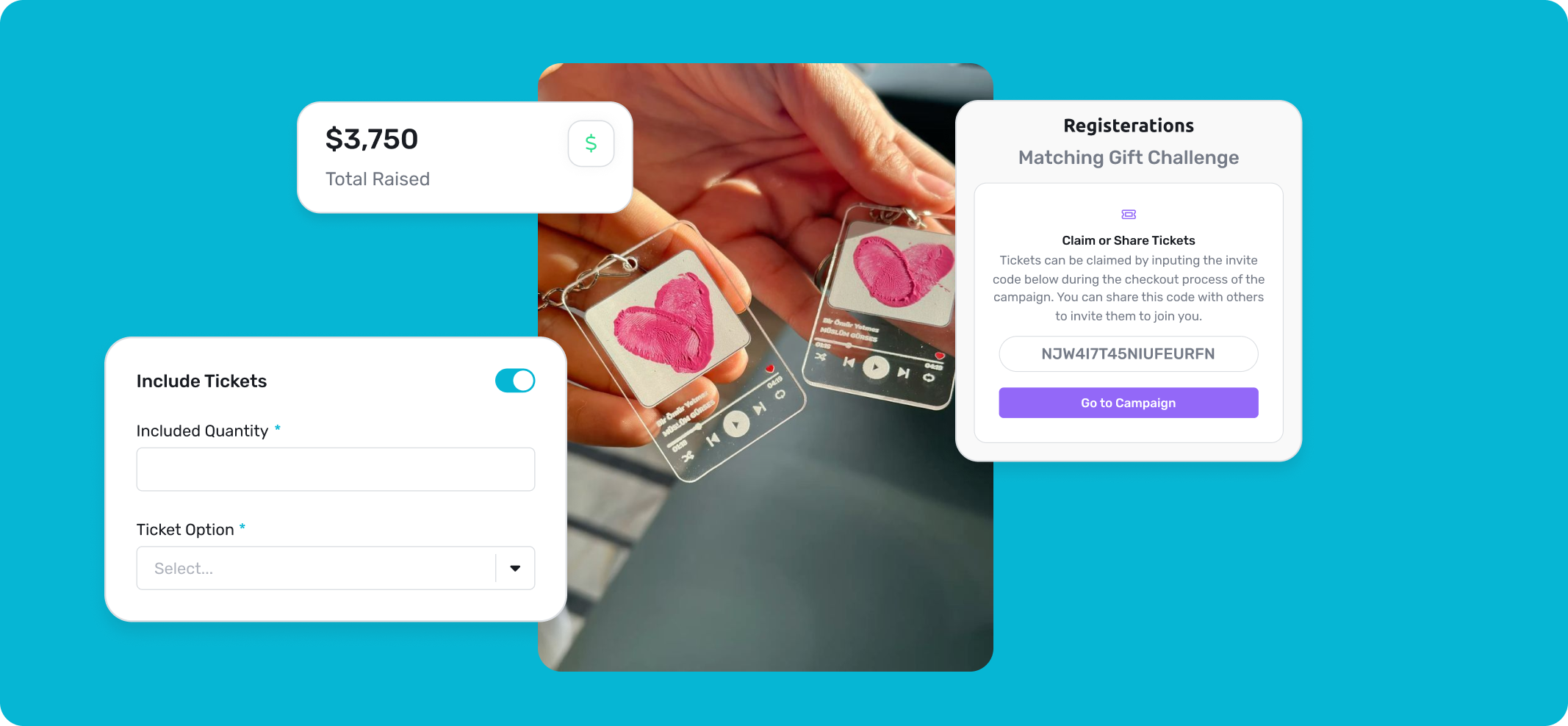
A matching gift challenge is a campaign where a sponsor or major gift donor matches donations up to a set amount by a deadline.
Say a sponsor will match up to $5,000. If 100 donors give $50 each, that's $5,000 in gifts, and the sponsor adds another $5,000 for a $10,000 total.
Tips to run:
- Set the cap at a level your donors can realistically fill.
- Announce the match two weeks ahead with exact terms.
- Add an employer matching lookup to your giving page.
- Decide in advance what happens when the cap fills.
3. Donor Count Unlock
Cost to run: Low, mostly staff time
Typical value: $10 to $50 per gift
Starting ask: $10
Tools: A donation wall, reporting and analytics, and centralized messaging
A donor count unlock is a challenge where a sponsor releases a set bonus once a target number of donors give.
Just over half of first-time donors for Giving Tuesday gave $50 or less in 2024, and this challenge counts every one of them. Set your target from last year's donor count.
Tips to run:
- Count each donor once, even if they give more than once.
- Display real-time gifts on a donation wall.
- Post donors remaining in every update, such as '37 more to go.'
Bundle 2: Community and Peer Power
These ideas put peer-to-peer fundraisers, local businesses, and board members in front, each one inviting their own circle to give.
4. Peer-to-Peer Ambassador Relay
Typical value: $100 to $250 raised per ambassador
Starting ask: $25
Tools: Simple registration, custom group leaderboards, and donation feeds
A peer-to-peer ambassador relay gives each supporter a two-hour shift on Giving Tuesday. During it, they share their personal page with their circle, then hand off to the next ambassador so your campaign stays visible all day.
A small, clear commitment makes it easier to recruit and retain ambassadors.
Tips to run:
- Match each ambassador to a different circle, like coworkers or alumni.
- Line up two backups for empty shifts.
- Group your leaderboard by workplace or city.
- Have each ambassador thank donors and tag the next one.
5. Tuesday Dine-Out for a Cause
Typical value: 10% to 25% of sales from your supporters
Starting ask: 10% of sales
Tools: Sponsor recognition, printed flyers or QR codes, and centralized messaging
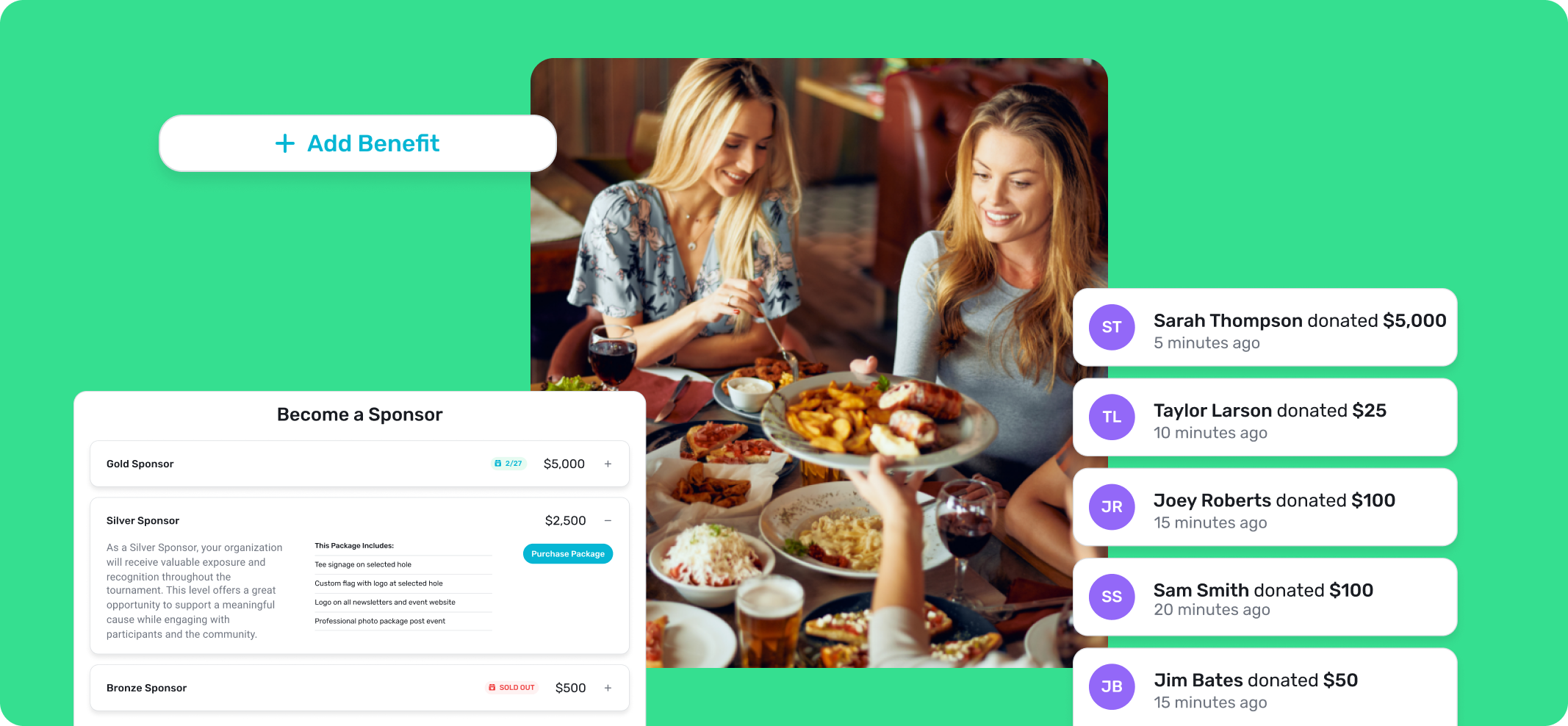
A Tuesday dine-out for a cause is a food fundraiser where a local restaurant donates a share of sales from your supporters.
After Thanksgiving weekend shopping, they can simply give by ordering dinner. Say 60 supporters spend $25 each: a 15% share of $1,500 is $225.
Tips to run:
- Pitch restaurants that want more Tuesday traffic.
- Put the percentage, hours, and excluded items in writing.
- Have supporters show a flyer or QR code at checkout, takeout included.
6. Thanksgiving Week Giving Tree
Typical value: $25 to $50 per tag
Starting ask: $10
Tools: Impact stories, a donation wall, and printed gift tags
A Thanksgiving week giving tree displays tags that each name one specific need, like a winter coat or a $25 gift. Supporters pick a tag in person or online and fulfill it by Giving Tuesday.
Tips to run:
- Name an exact item, size, or dollar amount on every tag.
- Offer a cash version of each tag for donors who can't shop.
- Hold a few tags back for late givers on Giving Tuesday.
- Describe each donated item on the receipt without stating a value.
7. Board Member Challenge
Typical value: $250 to $1,000 raised per board member
Starting ask: $50
Tools: A team dashboard, milestones and badges, and ready-made email drafts
A board member challenge gives each board member a personal fundraising page and a goal they can actually hit for Giving Tuesday. Each member gives first, then invites their own network, with standings posted by evening.
Tips to run:
- Send each member a ready-made email and a short script.
- Match each goal to the member's network size.
- Announce 100% board giving once every member has given.
Bundle 3: Giving Levels, Rewards, and Monthly Support
Each idea here gives donors a clear amount to give and a reason to give it. That clarity makes a difference in seasonal giving, when supporters want to see exactly what their contribution does.
8. Give What You Saved
Typical value: $10 to $50 per gift
Starting ask: $10
Tools: Centralized messaging, a campaign builder, and a shareable Giving Tuesday graphic
Give What You Saved asks supporters to donate the amount they saved on Black Friday and Cyber Monday deals. It turns a weekend of discounts into a gift on Giving Tuesday.
Tips to run:
- Launch the ask on Black Friday morning, while shoppers are hunting deals.
- Offer three easy options: all of it, half of it, or $10.
- Invite supporters to post their savings total and tag your page.
- Send a Cyber Monday email so the ask is fresh for Tuesday.
9. Founding Monthly Givers
Typical value: $10 to $30 a month per donor
Starting ask: $10 a month
Tools: Recurring giving, a donor portal, and built-in messages
Founding Monthly Givers invites supporters to join a recurring giving program on Giving Tuesday as a named founding group. Say 50 donors give $25 a month. That's $1,250 a month, or $15,000 a year.
Tips to run:
- Give the group a name and a perk, like a founder badge.
- Preselect monthly on your giving page and keep one-time as an option.
- Send each new monthly giver a welcome message within a day.
- Send a first impact update about 60 days after sign-up.
10. Choose Your Impact Giving Menu
Typical value: $25 to $250 per gift
Starting ask: $25
Tools: Connect dollars to impact, a progress tracker, and automated receipts
A giving menu works like an online fund-a-need: each gift level funds a specific outcome, such as meals, supplies, or program hours. Donors pick the result they want to fund, which makes a one-day appeal feel personal.
Tips to run:
- Price each level from your real cost per meal, kit, or hour.
- Keep the menu to four levels so choosing stays quick.
- Add a top-level for donors who want to fund a full program.
11. Merch Fundraiser
Typical value: $20 to $25 per shirt, with about $8 to $14 going to your cause
Starting ask: $20
Tools: Sales and inventory tracking, sold-out limits, and buyer shipping details
A merch fundraiser sells a Giving Tuesday T-shirt or hoodie that supporters wear and share. Each sale funds your cause, and the shirt keeps your name visible after the day ends.
Tips to run:
- Pre-sell shirts before Giving Tuesday and print only what's ordered.
- Price each shirt at least double your production cost.
- Set a limit per size so nothing is left over.
12. Gifts That Give Catalog
Typical value: $20 to $120 per gift
Starting ask: $20
Tools: Products on your campaign page, automated receipts, and printable gift cards
A gift catalog lists symbolic gifts, like a week of school lunches, that supporters buy in a loved one's name. The recipient gets a card, and the buyer gets a thank-you letter.
Tips to run:
- Include a free printable card and an instant e-card.
- Add a "where needed most" gift for buyers who can't choose.
- Send the catalog before Black Friday, as holiday shopping begins.
Bundle 4: Sponsors, Workplaces, and Friend Networks
A shop sponsors your goal, an employer rallies a team, a friend shares a link. That's peer-to-peer fundraising at work, and it carries your campaign past your own email list.
13. Corporate Sponsorship Drive
Typical value: $250 to $2,500 per sponsor
Starting ask: $250
Tools: Sponsorship sales and fulfillment tools, sponsor recognition, and centralized messaging

A corporate sponsorship drive asks local businesses, through a sponsorship letter, to sponsor your best Giving Tuesday campaign at set levels. Each sponsor gets recognition on your campaign page and in your posts.
Tips to run:
- Offer three levels, each with one clear benefit.
- Add an in-kind option for businesses without a cash budget.
- Send each sponsor a results recap the week after.
14. Workplace Giving Challenge
Typical value: $25 to $100 per employee gift
Starting ask: $25
Tools: Custom group leaderboards, team pages, and a team dashboard
A workplace giving challenge invites local companies or departments to compete on Giving Tuesday. Employees give through a shared team page, led by team captains, while a leaderboard tracks the standings.
Tips to run:
- Rank teams by participation rate, so small teams can win.
- Have each company name its captain at least two weeks ahead.
- Post standings midday so teams can respond.
15. Give $5, Grab Five Friends
Typical value: $5 to $25 per gift
Starting ask: $5
Tools: Social sharing, a donation wall, and Apple Pay and Google Pay
Give $5, Grab Five Friends asks each donor to give $5, then tag five friends to do the same. Every friend who gives tags five more keeps fundraisers motivated as the chain grows.
Tips to run:
- Ask donors to tag friends who already care about your cause.
- Post the running donor count each hour to keep the chain moving.
- Link to a mobile-ready giving page so each gift takes seconds.
Bundle 5: Online Live Moments
Online moments bring the energy of an event to supporters wherever they are. Give each one a set time, then plan a fundraising event around them and announce each time in advance.
16. 24-Hour Flash Silent Auction
Typical value: $100 to $200 per item
Start bidding at: 30% to 40% of fair market value
Tools: Dedicated auction pages, mobile bidding, and simple payments and receipts
A flash silent auction opens when Giving Tuesday begins and closes at midnight, so every bid lands within one day. Say a $200 dinner package opens at $75, which leaves room for bidding to climb.
Tips to run:
- Close items in three rounds, entry items first and premium last.
- Add a buy-it-now price at about 150% of value.
- State each item's fair market value on its listing.
17. Midnight Raffle Drawing
Typical value: $10 to $50 per supporter
Starting ask: $10 a ticket
Tools: Fast setup, mobile-friendly checkout, and winner drawing
A midnight raffle sells entries through Giving Tuesday and draws the winner live as the day closes. Tickets sell at $10 each or three for $25, so 100 bundle buyers bring in $2,500.
Tips to run:
- Ask your state gaming office if online ticket sales are allowed.
- Run a 50/50 pot if you can't source a prize.
- Offer entries as an add-on at your donation checkout.
- Stream the draw and show the randomizer on screen.
18. Livestream Telethon
Typical value: $25 to $100 per viewer gift
Starting ask: $25
Tools: A donation wall, a progress tracker, and a free livestream tool
A livestream telethon is a short live show on Giving Tuesday, split into segments that each carry a small giving goal. Viewers give through your crowdfunding page, and the show moves on when a goal is met.
Tips to run:
- Tie each story to one gift amount.
- Read donor names aloud as gifts appear on your donation wall.
- Pin your giving link in the chat and repeat it each segment.
Bundle 6: In-Person and Hybrid Events
In-person events take the most planning, so decide early whether your team can staff and fund one. A hybrid fundraising event lets supporters at home join too, which widens your reach beyond the room.
19. Black Friday to Tuesday Step Challenge
Typical value: $1 to $5 a mile
Starting ask: $25 flat or $1 a mile
Tools: Activity tracking and a leaderboard
A Black Friday to Tuesday step challenge is a five-day walk-a-thon fundraiser where walkers log steps and donors give per mile or a flat amount. Say a walker covers 20 miles and 10 donors give $1 a mile: that's $200.
Tips to run:
- Cap per-mile gifts so donors know the most they'll owe.
- Offer a flat option for donors who prefer a fixed gift.
- Have walkers log steps daily so donors can follow progress.
20. Giving Tuesday Gala Night
Typical value: $100 to $250 per ticket
Starting ask: $100 a ticket
Tools: Multiple ticket types, table seating, and live donation displays
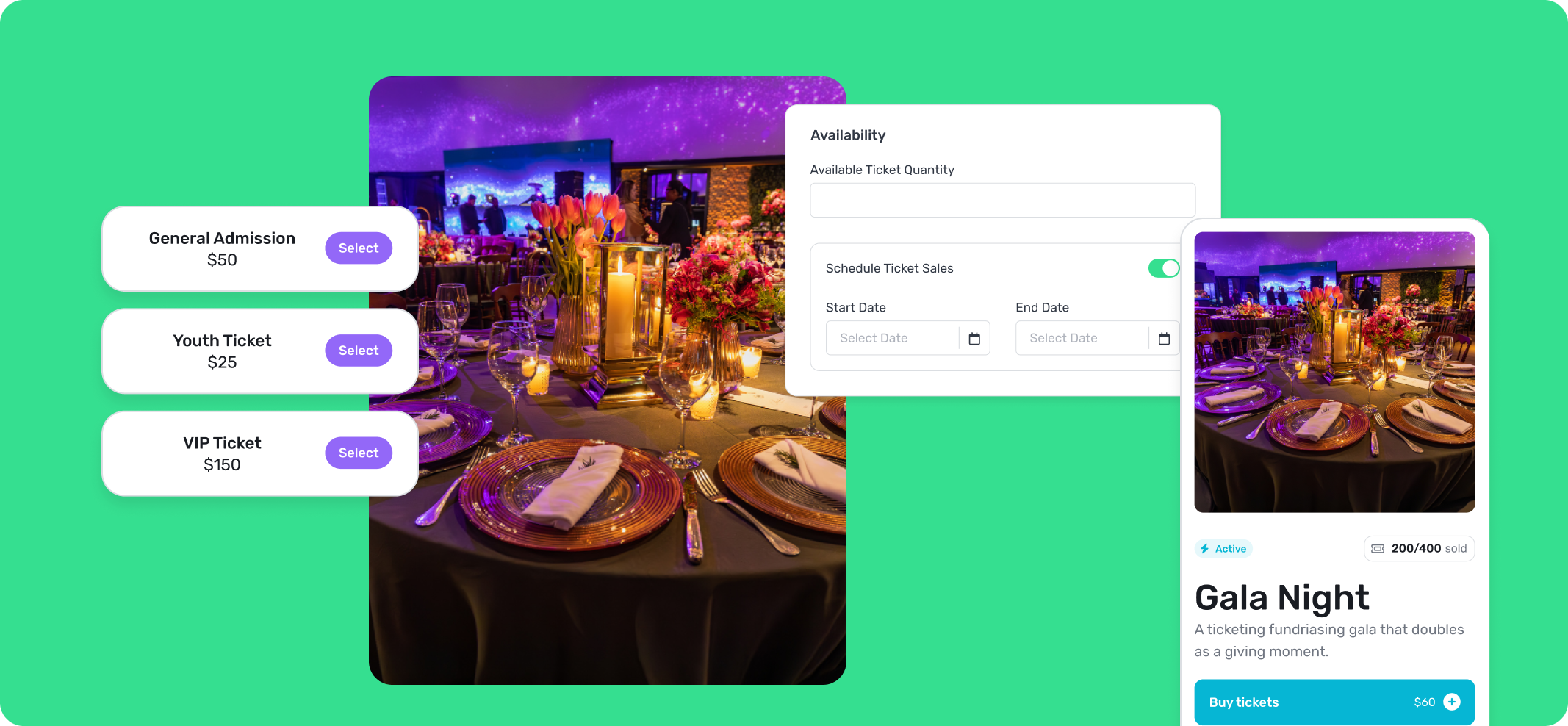
A Giving Tuesday gala night is a ticketed fundraising gala that doubles as a giving moment. UNICEF USA's 2025 gala, held on Giving Tuesday, generated more than $1 million of its $7.4 million day.
Tips to run:
- Price tickets as event cost plus your goal, divided by expected guests.
- Sell sponsor tables first, so ticket sales go further.
- Keep your giving page open all day for supporters who can't attend.
21. Giving Tuesday Holiday Market
Typical value: $75 to $150 per vendor booth
Starting ask: $75 a booth
Tools: Multiple ticket types, custom questions, and QR code scan to give
A Giving Tuesday holiday market is an event fundraiser where local vendors pay a booth fee to sell for one evening. Shoppers buy gifts from neighbors while your giving page collects donations.
Tips to run:
- Charge a flat booth fee that vendors can plan around.
- Post a QR code at every booth so shoppers can give on the spot.
- Ask each vendor to invite their own followers.
Looking for more interesting ideas for the winter? Here’s our list of the best winter fundraising ideas for the upcoming season.
How to Choose the Right Giving Tuesday Idea for Your Nonprofit
Your best idea depends on three things: who your supporters are, how many people can help, and how far ahead you can plan. Pick one anchor idea, then add one low-effort idea to run alongside it.
How to Prepare for Giving Tuesday
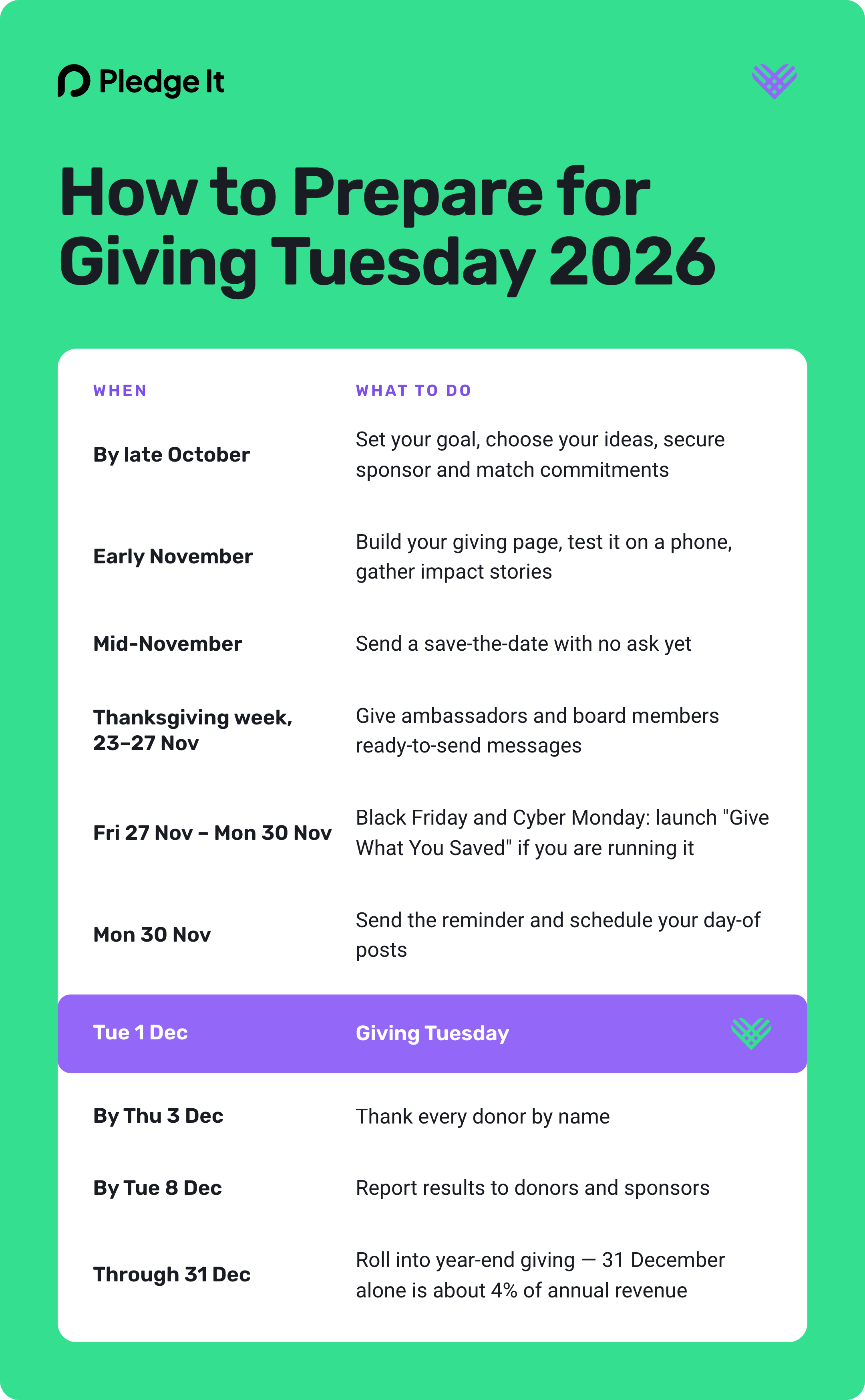
Most of a Giving Tuesday campaign is decided before the day, and since it falls in late November or early December, planning starts in the fall. Work backward from the date and assign one job to each stretch.
- October: Set your goal, choose your ideas, and secure sponsor and match commitments.
- Early November: Build your giving page, test it on a phone, and gather impact stories.
- Mid-November: Send a save-the-date with no ask yet.
- Thanksgiving week: Give ambassadors and board members ready-to-send messages.
- The day before: Send a reminder and schedule your day-of posts.
Giving Tuesday Best Practices for Nonprofits
Once the day arrives, a few habits keep your campaign steady. What follows is donor stewardship, and it shapes who gives again.
- Kick off in the morning: Share the goal, the giving link, and the day’s schedule.
- Show impact: Post one of your gathered impact stories at midday.
- Assign owners: One person per task, from gifts to questions.
- Rally in the evening: Share progress between 5 and 7 PM, then announce any closing bonus or draw in the final hour.
- Thank within 48 hours: Use each donor's name.
- Report within a week: Share results with donors and sponsors, and what the funds will support.
- Track three numbers: New donors, average gift, and form conversion, by idea.
Your Giving Tuesday Campaign Starts Now
Here's what the ideas in this guide have in common: each one gives supporters something to do. They give, share, bid, or join, and that role makes a one-day campaign feel personal.
A role also gives people a reason to come back next year.
So, where do you begin? Start with one partner, like a sponsor, a board member, or a friend with a loyal circle. One yes often gets the whole campaign moving.
When you're ready to build, Pledge It, the complete event fundraising platform, keeps your crowdfunding page, sponsorships, auctions, raffles, and peer-to-peer teams in one place. That leaves your team free to spend the day with supporters.