How do you vet fundraisers before they lock up a bib and ghost you in November? How do you protect cash flow when someone walks away from their commitment? How do you turn a one-time runner into a five-time advocate who brings their friends?
This guide covers peer-to-peer fundraising best practices from the operator's side, specifically through one of the highest-ROI formats in the space: the charity bib program. A charity bib program is a partnership where a nonprofit secures guaranteed entries to a sold-out endurance race, and runners commit to raising a minimum dollar amount in exchange for access.
The operational playbook below draws from Rick Smith, Executive Director of Hope Story, who has grown a charity running program to more than 1,600 runners per season and $1.3 million raised on Pledge It in roughly 18 months.
Before getting into the charity bib playbook, here's how the peer-to-peer model works at a basic level.
How Peer-to-Peer Fundraising Works
In a peer-to-peer fundraising campaign, a nonprofit recruits individual fundraisers who each create their own fundraising pages and ask their personal networks to donate. Instead of one organization collecting donations from a single campaign page, you have dozens or hundreds of individual fundraising pages running simultaneously, each one reaching potential donors who likely never heard of your organization before.
The reach is the whole point. A fundraiser who shares their personal fundraising page with friends, family, and coworkers is doing donor acquisition work your marketing budget can't replicate. When those individuals organize personal campaigns around a shared event or challenge, the effect compounds: peer-to-peer pages go out across social media platforms, fundraising goals get posted and shared, and new supporters find your cause through someone they already trust.
The best peer-to-peer fundraising programs layer a few things on top of that basic mechanic: a clear fundraising strategy, consistent communication to keep individual fundraisers on track, and an event or challenge that gives volunteer fundraisers a reason to ask. The charity bib program is one of the most effective formats for doing all three at once, and the operational playbook for running one transfers directly to walks, rides, golf tournaments, and any other peer-to-peer fundraising event your organization runs.
The Charity Bib Model: Why It Works and Who It Works For
A charity bib program pairs a nonprofit with a race organizer: the race sets aside guaranteed entries for the nonprofit's runners, and those runners earn their spot by committing to raise a minimum dollar amount for the cause. The model works because each of the three parties gets something they couldn't get on their own.
Race organizers allocate a fixed number of bibs, sometimes called slots or guaranteed entries, that are withheld from the general public registration. These bibs go exclusively to nonprofit partners. Nonprofits then market those bibs to potential runners. Runners apply to the nonprofit for one of the limited slots, and in exchange for the guaranteed entry, they commit to raising a minimum dollar amount for the cause. Fundraising minimums range from a few hundred dollars at smaller regional races to $10,000 or more at marquee events.
The model works because every party gets something they could not get on their own.
For runners, it’s access. The New York City Marathon, the Chicago Marathon, the Boston Marathon, Disney’s race weekends, and Big Sur are all famously hard to enter through the lottery. Some runners apply for years and never get in. A charity bib bypasses the lottery entirely. It also adds purpose. Training for a marathon is a six-to-nine-month commitment, and running for a cause gives that effort a meaning beyond personal accomplishment.
For nonprofits, it’s guaranteed revenue plus visibility. Each runner is a fundraiser, raising on average several thousand dollars and sharing their training journey with their personal network for months before race day. As Rick put it, “people sign up to run a race with Hope Story because they want to run a race at Disney World. They want to run the New York Marathon. They probably don’t even know what we do.” That’s exactly the opportunity. You’re acquiring future advocates through the access you control.
For race organizers, it’s community impact and a more engaged participant base. Charity runners aren’t there to PR. They’re there to celebrate finishing and to celebrate raising money. They bring spectators, stories, and the kind of energy that turns a race into an event.
Getting Your First Charity Bibs (It Usually Takes More Than One Try)
The first charity bib partnership is the hardest one to land. Race organizers, especially at marquee events, get many more applications than they can accommodate, and they need to be convinced that your nonprofit will actually move bibs and represent the race well.
Rick’s first application to the New York City Marathon was denied. So was the second year, in the middle of COVID. He kept applying. Eventually, Hope Story was approved with a small initial team, and that first cohort became the foundation on which everything else was built on.
The takeaway is not “be patient.” The takeaway is, don’t wait for everything to be perfect before you apply.
Rick said it directly: “Sometimes people want to wait till they have every single detail figured out before they move forward. But the problem is you’ll never be able to get everything perfect. If you get into that trap of waiting till you have it all figured out before you start, you’ll never start... We’re just kind of learning as we go.”
How to actually apply:
- Pick races that fit your nonprofit’s audience. Hope Story specifically targets destination races—events people would want to make a trip out of. They explicitly avoid their local Dallas race because runners there would always be able to get in without the charity bib. Scarcity is the whole point.
- Search “[race name] charity partner program” or “[race name] charity bib program” and find the application. Most major races have an annual window, often announced a full year in advance.
- Submit a strong organizational profile. A 501(c)(3) status, a clear mission, a fundraising strategy that shows how you'll recruit and engage supporters, and a clear plan for hitting your fundraising goals within your community.
If you get denied, apply again. Keep showing up at races, whether as a participant or a spectator. Introducing yourself to race directors in person is one of the most underrated ways to build these partnerships. Rick is direct on this: “That’s really invaluable, to get there and let them know we want people to know... hey, we’re here. We’re creating a good experience for these runners.”
Setting Fundraising Minimums Without Leaving Money on the Table
Setting fundraising minimums is one of the most consequential decisions you’ll make, and most nonprofits get it wrong in both directions. They set it too low because they’re afraid of scaring off applicants, or they copy a competitor’s number without understanding what that competitor includes in the experience.
Rick’s approach is simple: research the market, then adjust based on what you actually deliver. “Creativity is forgetting where you saw it,” he says.
Look at what other nonprofits charge for the same race. Use ChatGPT or a Google search to surface comparable charity fundraising campaigns. Then ask: what does that commitment cover?
“If you see an organization like Hope Story and our commitment is $5,000 for the New York Marathon, and... [think] I’m going to do the same thing. Is it apples to apples? With Hope Story, we do a team dinner that we pay for. We do a shakeout run that our staff [does] on Saturday morning. We have a team send-off and breakfast on Sunday morning before the marathon. All of our runners get gear at no additional cost. We have expenses built into that. If you say, I’m going to do $5,000, but I’m not going to do anything [else], that’s not really apples to apples.”
Hope Story’s current minimums illustrate the range:
- New York City Marathon: $5,000 commitment
- Big Sur 11-mile: lower commitment, after they learned the marathon was harder to fill than the 11-miler
- Disney’s Dopey Challenge (four races): $2,500 combined commitment
Don’t be afraid to raise minimums once your program is established. Rick’s organization increased commitments over time as the experience improved: dinners, gear, staffing at every race, handwritten notes in swag boxes, and race-weekend breakfasts. The more value you build into the experience, the more your minimum can justify.
And be willing to lower minimums when the data tells you to. Hope Story set Big Sur marathon bibs at $3,000 the first year, assuming they’d be in high demand. They weren’t. Hope Story had to negotiate down individual commitments mid-cycle and learned that the 11-mile race was actually the more popular product for that destination. They reduced minimums for the marathon and reallocated bibs to the 11-miler the following year.
The principle: your fundraising minimum is a pricing decision, and you should price-test it like one. This fundraising tip applies cleanly outside of running—the same logic governs minimums for golf foursomes, charity walks, gala team tables, and any other fundraising events your nonprofit supporters participate in. Whatever you charge has to reflect what you actually deliver, and you have to be willing to adjust both directions when the data tells you to.
Vetting Fundraisers: Build an Application That Filters for Fit
Every charity bib program has the same operational nightmare: a runner signs up, locks up a bib that could have gone to a committed peer fundraiser, then ghosts your team and raises nothing. You’re left two weeks before race day, trying to backfill a slot that requires months of training, and the original runner doesn’t care because they got what they wanted.
The solution is upstream. Build a real application process and use it to identify red flags before they become problems.
Hope Story’s application process has a few non-negotiable elements:
Everyone applies, every time. Even runners who have run with Hope Story ten times still fill out the application. The form captures motivation (“Why do you want to run with Hope Story?”), connection to the cause, and which race or races they want to apply to.
Multi-race applications get a flag. A family of four signing up for the Dopey Challenge at $2,500 each is a $10,000 fundraising commitment in a single application. That’s a lot of bibs and a lot of cash flow risk. Those applications get reviewed with extra care.
Repeat applicants get screened against history. Rick’s team uses notes in their fundraising platform to track previous behavior. If someone defaulted on commitments, ghosted communications, or submitted a fraudulent payment card in a previous cycle, they are added to an internal “do not call” list. They can still apply, but they don’t get approved.
The application form sets expectations in writing. Hope Story is explicit that the bib is non-transferable, non-cancelable, and that individual fundraising commitments will be enforced. People sign acknowledging this before they get a bib code.
The instinct to be lenient is real, and it’s the wrong instinct. As Rick put it: “It feels mean when we hold people to standards, but it’s not mean to say, hey, you signed up. You told us this is what you were going to do. You didn’t do it. We’re not firing you. You basically fired yourself by not following through.”
The earlier you remove runners who won’t fundraise, the more time you have to fill their slot with someone who will.
The 50% Deadline: How to Protect Your Fundraising Revenue With a Credit Card on File
This is the operational protocol that changes the math of charity bib programs more than any other. If you take one thing from this guide, take this.
When a runner is approved and accepts a bib, a credit card is required on file. Put it in writing that the card will be charged for any unmet portion of the fundraising commitment—this is your single biggest lever for protecting your fundraising efforts and keeping individual fundraisers accountable.
Set two enforcement deadlines:
- 50% deadline. Halfway between approval and race day, every runner must have raised at least half of their committed amount. If they haven’t, you charge the card for the difference.
- 100% deadline. Approximately two weeks before race day, every runner must be at 100%. If they’re not, you charge the card for the remainder.
Why two deadlines instead of one? Two reasons that compound on each other:
Reason one: cash flow protection. If a runner is going to default, they almost always default at the end. Cards get declined right before the race when there’s nothing you can do about it. By attempting a charge at the 50% mark, you find out early whether the card will work, and you find out while you still have months to release the runner, reopen the slot, and recruit a replacement. Rick: “If you do a 50% mark and you say we’re going to charge your card at the 50% point, if their card is declined, we now have a long runway to find another runner to take their bib.”
Reason two: behavioral commitment. Once a runner has paid in 50% of their commitment, walking away costs them money. “Getting that 50% is key because someone doesn’t want to lose all of that. It’s a lot easier to get someone to go from 50% to 100% than to get someone to go from 0% to 50%.”
Hope Story takes this one step further with Disney runners: they don’t release the actual Disney race registration code until runners hit the 50% mark. That’s a hard gate. No money, no race.
This level of enforcement requires two things:
- Fundraising software that supports credit cards on file, plus partial and final charge dates per runner. (This is one of the operational protocols Pledge It was built around. See the Pledge It charity bib management features.)
- The discipline to actually enforce the deadlines consistently. If you let some runners slide, the protocol stops working.
Be consistent and be communicative. Hope Story emails every runner their balance monthly, and now sends platform-native reminders at scheduled intervals so that when a deadline passes and a card gets charged, no one is surprised.
The 50% deadline protocol works for any fundraising event in which a participant commits to raising a target amount: golf tournaments, charity walks, rides, climbs, A-thons, and team galas. Anywhere you're absorbing a per-participant cost in exchange for a fundraising commitment, a partial-charge deadline at the midpoint is the single highest-leverage operational change you can make.
Fundraising Tips for Keeping Peer Fundraisers on Track Without Burning Out Your Team
The 50% deadline only works if you’ve been communicating along the way. Otherwise, the charge feels like a gotcha, and you’ve lost a future advocate even when you’ve recouped the money.
Hope Story’s communication cadence is built around a simple principle: as early as possible, as often as possible. People are procrastinators. They sign up six months before a race, and they intend to start fundraising in five and a half months. Your job is to keep their fundraising commitment on their radar from day one.
What that looks like in practice:
- Monthly balance emails. Every runner receives a monthly email showing their fundraising progress against their commitment. With 1,600 runners across multiple races, this can’t be done by hand. Hope Story sends these from their fundraising platform.
- Behavioral monitoring of zero-percent runners. The most important segment to watch is the runners who have raised exactly $0. They’re not a hundred different problems. They’re one problem, repeating itself. Reach out to them personally. If they ghost you across multiple channels, that’s your signal to release them at the next deadline.
- Notes in the system on every flag. Every time a runner needs to be chased, defaults on a payment, or asks for an exception, the interaction goes in the runner’s record. Future cycles read those notes.
Tough conversations early, not late. When someone is at risk of missing the 50% mark, the conversation needs to happen at the 25% mark, not the 49% mark. Empathy is fine. Empathy plus six months of warning emails is also fine. Empathy alone, at the last minute, is how programs lose money.
Race Day: Where Repeat Runners Are Made
A charity bib program that treats race weekend as a transaction will struggle to grow. A program that treats race weekend as a community moment can compound year over year on repeat runners and word-of-mouth. The difference is staffing, intentionality, and a stack of small touches that add up.
Hope Story’s race-weekend playbook:
- Pre-trip touches. Every runner gets a curated Spotify playlist matched to the destination (New York hits for New York, Disney songs for Orlando), a handwritten note, and a swag box delivered in advance.
- Staff on the ground at every race. Hope Story sends at least one staff member to every race, and more for the big ones. New York and Disney get multiple staff. The cost is real (flights, hotels, time), and it’s the single expense Rick says he would never cut.
- A team meeting on race weekend. Mandatory for marquee races. Hope Story does a kickoff team meeting at New York with the expectation that attendance is non-negotiable. They’ve had runners join from cruise ships and from other countries because the expectation was set at signup.
- A team social, a shakeout run, and a sendoff breakfast. The structure varies by race, but the pattern is consistent: gather the team multiple times across the weekend.
- Visible cheering on the course. Hope Story staff wear oversized backpack signs and station themselves on the course until every single runner crosses the finish line. In New York, that means staying until dark.
- A survey within 24 hours of the last race. Capture what worked, what didn’t, and where they want to run next.
- The race-weekend ask for the next race. Excitement is highest in the hours after a race. That’s the moment to share the link to next season’s race calendar.
The relational layer is what generates repeat runners, and repeat runners are the only sustainable growth engine in this model. Rick’s framing is direct: “If you want to do it next year and you want to do it for other races, you’re going to have to find 25 more people, 25 more people, and eventually you run out of people. So you’ve got to figure out ways to keep those runners coming back.”
The same logic applies to any peer-to-peer fundraising event. A golf tournament that treats Saturday as a transaction is a one-shot. One that creates a real foursome experience and asks captains to come back next year is the start of an annual tradition. The format is different. The principle is the same.
The One Expense to Never Cut: Staff at Your Fundraising Events
Asked what he would never cut from the program budget, Rick didn’t hesitate: staff at the events.
“A lot of people run these races by themselves. It’s their first race. No one’s cheering them on. They have nobody supporting them. Nobody’s holding up a sign for them. And we want people to know, hey, if you come to one of the races and you’re running for Hope Story, you’re going to have people cheering you on, encouraging you, and you’re never alone if you run a race with Team Hope.”
If you have to make a cut, cut elsewhere. Cut the swag box. Cut the dinner. Cut a race partnership. Your active fundraisers deserve to have someone in their corner on race day. Don't send a runner to a marathon without a staff member present.
Scaling the Administrative Side: The 5,000-Text-Message Problem
The thing Rick wishes someone had told him before he started: the administrative work of a growing charity bib program is non-obvious and enormous.
The math is sobering. With 1,600 runners in a cycle, a single congratulations email is 1,600 emails. A single balance update is 1,600 more. A text with a video from a Champion of Hope is 1,600 text messages. Hope Story now sends three videos per runner per cycle, which is approximately 5,000 text messages per cycle, manually, unless they automate.
The implication for any program that wants to scale:
- Hire or assign someone whose primary skill is administrative operations. Not just admin support. A real operations brain. Without this person, the founder or ED becomes the bottleneck.
- Pick fundraising software that consolidates the workflow. Application intake, bib management, individual fundraising pages, credit card on file, deadline enforcement, segmented messaging, and reporting should all live in one central campaign page and system. Spreadsheets work at 25 runners. They break at 250. Pledge It is built to solve exactly this problem, and it's the platform Hope Story uses to manage their program.
- Automate communications by segment, not individually. Send to “0% fundraisers” as a segment. Send to “50%-to-100% deadline approaching” as a segment. Personalization at scale means using your own campaigns to reach the right people at the right time—segmentation done well.
The administrative load is the single biggest reason early-stage programs plateau at 50 or 100 runners. Many nonprofits underestimate this until they're already underwater. Build for the scale you want before you need it.
Frequently Asked Questions
What is peer-to-peer fundraising?
Peer-to-peer fundraising is a model where a nonprofit recruits individual supporters to fundraise on its behalf, typically tied to a personal milestone or shared event. Each supporter creates their own fundraising page, shares their personal story with their network, and asks their connections to donate, reaching donors who would never have found the organization on their own.
Common formats include charity bib programs at marathons, charity walks, charity rides, golf tournaments, A-thons, and giving days. The frameworks in this guide focus on the operator side: how to run a peer-to-peer program that actually grows.
What is a charity bib program?
A charity bib program is a partnership between a race organizer and one or more nonprofit organizations in which the race allocates a number of guaranteed entries (bibs) to each nonprofit. The nonprofit distributes those bibs to runners who commit to raise a minimum dollar amount for the cause in exchange for the guaranteed entry into a sold-out or hard-to-enter race.
What is the difference between peer-to-peer fundraising and crowdfunding?
Crowdfunding is a method of raising funds that collects donations on a single page from many donors. Peer-to-peer fundraising is a nonprofit model that recruits many individual supporters, each of whom creates their own fundraising page and asks their personal network to give. The reach is multiplicative. A nonprofit with 1,600 peer-to-peer fundraisers can plausibly reach hundreds of thousands of prospective donors through participants’ networks in a single cycle, most of whom would never have found the organization on their own. Crowdfunding works best for a single, time-bounded ask. Peer-to-peer is the format when you want sustained acquisition of new donor relationships.
How does a nonprofit get charity bibs for a marathon?
Apply directly to the race organizer through their official charity partner program. Most major marathons, including New York, Boston, Chicago, and Big Sur, open an annual application window roughly a year before the race. Applications typically require 501(c)(3) status, an organizational profile, and a plan for promoting the race within the nonprofit’s community. Denials are common, especially for marquee races. Reapply.
How do you recruit fundraisers for a peer-to-peer campaign?
Treat recruitment as a year-round motion, not a one-time push. The most efficient source is repeat fundraisers and the people they bring with them: the post-event ask delivered when excitement is highest, the team alumni email list, and the captains who keep bringing friends back. For new participants, the best channels are personal outreach, a strong social media presence, the nonprofit's own email list, and showing up in person at smaller community events to invite supporters and introduce the organization.
What is a typical charity bib fundraising minimum?
Fundraising minimums vary widely by race and by nonprofit. Smaller regional races may set minimums in the $500-$1,000 range. Marquee marathons like New York or Boston often range from $3,000 to $10,000 or more. The minimum should reflect both market rates and what your program delivers in return: gear, dinners, race-weekend programming, and staff support all justify higher minimums.
How do you handle runners who don’t meet their fundraising commitment?
Require a credit card on file at signup, set explicit fundraising deadlines at 50% and 100% of the commitment, and charge the card for the difference when deadlines are missed. The 50% deadline is the critical one. It surfaces problem runners while there’s still time to release them and recruit replacements.
Does the 50% deadline protocol work for events other than running?
Yes. The mechanic transfers to any peer-to-peer format where the nonprofit absorbs a per-participant cost in exchange for a fundraising commitment: golf foursomes, charity walks, rides, climbs, A-thons, and team galas. Anywhere there’s a real cost per slot, a partial-charge deadline at the midpoint is the highest-leverage operational change you can make. It surfaces declined cards while you still have months to release the participant and recruit a replacement, and it creates a behavioral commitment that makes the second half of fundraising materially easier than the first.
How do you keep fundraisers motivated and on track?
Communicate as early as possible and as often as possible. Send monthly balance emails from the day someone is approved. Segment outreach by status (the goal is to encourage participants before they fall behind, not after). The 0% segment is the single most important to chase personally, ideally before they hit the 25% mark on the calendar. Keep notes in the platform on every interaction so the next cycle can read the history. Ongoing support and clear communication of deadlines empower supporters to hit their goals. Have the tough conversations at the 25% mark rather than the 49% mark. Empathy is fine. Empathy plus six months of warning emails is also fine. Empathy alone, at the last minute, is how programs lose money.
What peer-to-peer fundraising platforms do charity running programs use?
The most important features for charity bib management are application intake with custom forms, bib inventory tracking per race, credit card on file with scheduled partial and final charges, segmented messaging, individual fundraising pages, and clear reporting on commitment vs. raised. Most organizations end up patching this together across three tools: a peer-to-peer fundraising platform, a Google Form for applications, and a spreadsheet to track everything. The problem is that approach breaks down fast as your program grows.
Pledge It is purpose-built for this workflow and lets you manage applications, bib inventory, fundraising deadlines, and participant communication in one place. General peer-to-peer platforms like GoFundMe Pro, GiveSignup, and Givebutter can also be configured for charity bib management, with varying levels of native support.
How many staff should a nonprofit send to a charity event weekend?
At least one staff member at every event, more for the marquee ones. Hope Story sends multiple staff to New York and Disney. The cost is real (flights, hotels, time), and it’s the single expense Rick says he would never cut. As he put it: “A lot of people run these races by themselves. It’s their first race. No one’s cheering them on. They have nobody supporting them. Nobody’s holding up a sign for them. And we want people to know, hey, if you come to one of the races and you’re running for Hope Story, you’re going to have people cheering you on, encouraging you, and you’re never alone if you run a race with Team Hope.”
How do you grow a peer-to-peer fundraising program year over year?
Growth comes from two compounding mechanics. The first is protecting the revenue you already have: build a campaign plan around enforcing fundraising minimums, run the 50% deadline with a credit card on file, and keep notes on every participant so problem fundraisers don't recycle into the next cycle. The second is converting first-time fundraisers into repeat fundraisers and advocates.
The relational layer at event weekend (staff on the ground, team meals, the next-event ask delivered in the post-finish glow) is the single biggest lever on repeat rate. New-participant acquisition alone runs out of road. As Rick put it: “If you want to do it next year, you’re going to have to find 25 more people, 25 more people, and eventually you run out of people.”
Should we focus on first-time runners or repeat runners?
Both, but repeat runners are the growth engine. Acquisition costs are real, and any program that grows through first-time runners alone will eventually run out of new people. The best programs invest disproportionately in repeat-runner experience: staff at races, social events, exclusive race-weekend programming, and the next-race ask delivered in the moment when excitement is highest.
How much does it cost a nonprofit to run a charity bib program?
The two largest cost categories are bib fees (paid to the race organizer, typically per bib) and race-weekend staffing (flights, hotels, time). Both should be modeled against expected per-runner fundraising. A well-run program at $5,000 per runner with $200 in bib costs and $300 per runner in race-weekend programming still nets approximately $4,500 per runner before processing fees.
What’s Next
Building a successful peer-to-peer fundraising program for endurance events is one of the highest-leverage moves a nonprofit can make if you have the operational discipline to enforce minimums, the relational instincts to empower supporters to become advocates, and the administrative infrastructure to handle the message volume at scale.
Charity bib programs are the highest-ROI version of this model in the running space, and the playbook transfers to walks, rides, golf, and any other peer-to-peer format your organization runs.
If you’re starting from zero with charity bibs, pick one destination race, apply early, and reapply if you're denied. If you already have a peer-to-peer program and you’re losing money to fundraisers who don’t meet their commitments, the 50% deadline with a credit card on file is the fastest fix, regardless of event type.
This article draws on a Pledge It webinar featuring Rick Smith, Executive Director of Hope Story, and Dave Costlow, President of Pledge It. Hope Story provides no-cost resources to families whose children have been diagnosed with Down syndrome. Their charity bib program supports the mission through more than 1,600 runners per season across destination races, and has raised over $1.3 million on Pledge It in about 18 months, crossing the $1 million milestone earlier this year.
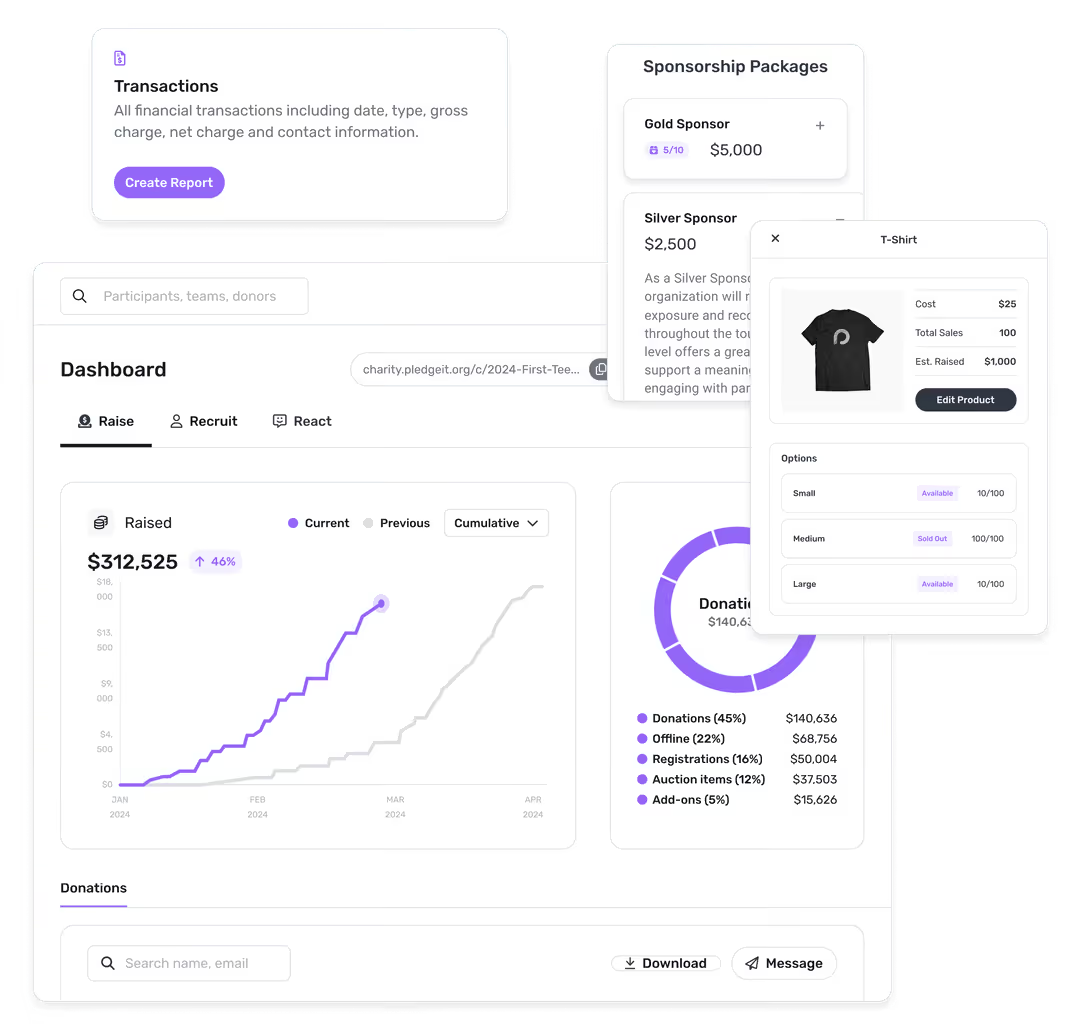
Get a closer look at how Pledge It manages peer-to-peer fundraising applications, deadlines, and participant segmentation in a single workflow.