Before 2020, picking a single event format meant picking who gets left out. Sometimes it was the out-of-town donor, and sometimes it was the supporter who just prefers to give from their couch.
As online event hosting became mainstream and eventually the only means to run one during the global pandemic, the fundraising world saw innovations.
Hybrid fundraising events emerged as a creative way post-pandemic to engage two sorts of audiences in the same campaign.
This is no longer a niche approach. 74.5% of event planners were already using hybrid formats in 2025, balancing reach, cost, and attendee preference in a single event. It's become a standard way to run a fundraiser.
We’ll explain what a hybrid fundraising event really is, how to run one, and what to include in your event checklist.
What Is a Hybrid Fundraising Event?
A hybrid fundraiser combines an in-person gathering with a live virtual component, so both audiences experience the same event at the same time.
This means your in-person guests are in a room while remote supporters join through a livestream, and both groups can give, bid, or participate through a connected system.
This differs from a purely virtual event, where everyone joins online, and from a traditional in-person event, where anyone who can't attend simply misses out. Hybrid fundraising captures the strengths of both.
Learning how to organize a fundraising event for the hybrid setup mostly comes down to treating the online audience as a real part of the room instead of an add-on watching from a distance.
Why Nonprofits Run Hybrid Fundraising Events
These events broaden who can take part and how much they give, without asking your team to run separate events. A single well-run hybrid fundraising event can outperform two smaller ones split by format. Here's what that looks like in practice:
Diverse and Inclusive Participation
A hybrid format welcomes supporters regardless of location, mobility, schedule, or comfort with large gatherings.
Nobody has to choose between showing up and being included. That change often grows your audience more than other marketing pushes.
Richer Donor Data
Online participation generates data by default, like who joined, how long they stayed, when they gave, and what they bid on. Over a few events, that builds a picture of engagement that no sign-in sheet can produce.
Higher Sponsorship Value
Sponsors reach both a live room and an online audience for one investment. That expanded visibility often justifies a bigger sponsorship ask than an in-person-only event. It's an easier renewal conversation the following year, too.
Structure the package around it. Split benefits into three buckets and price the tiers accordingly:
- In-room only (signage, table)
- Stream only (lower-third graphic, pre-roll slide)
- Both (verbal mention during the shared appeal)
A sponsor who sees their logo on the stream graphic during the fund-a-need has evidence to take back to their marketing team.
Increased Fundraising Potential
Online and hybrid formats consistently outperform in-person-only events in fund collection. Hybrid events can raise about 15% more than fully in-person ones.
55% of fundraising professionals even report better ROI from virtual or hybrid formats. More ways to attend tend to mean more ways to give.
Greater Event Impact
A larger, more varied audience means your mission reaches further than the room you rented.
That reach often outlasts the event itself, through shares, recordings, and word of mouth, promoting next year's event before you've even planned it.
Step-by-Step: How to Run a Hybrid Fundraising Event
Running hybrid fundraising events well comes down to planning for both audiences from day one. Here's the process, broken into 9 steps:
Step 1: Set Clear Goals
Before picking a format or a date, decide what this event needs to accomplish. A fundraising target, a donor acquisition goal, and a stewardship-focused gathering all call for different choices later on.
- Write down one primary goal and one secondary goal for the event.
- Set a specific dollar target, not a vague hope to 'do well.'
- Decide how you'll measure success beyond total dollars raised.
Step 2: Budget For Two Cost Centers
A hybrid event has 2 cost centers: your venue and your virtual production. Build both into the budget from the start, rather than treating streaming as a minor add-on.
- List venue, catering, and staffing costs separately from tech and streaming costs.
- Set aside a contingency fund of at least 10% for last-minute needs.
- Confirm which costs are fixed and which scale with attendance.
Step 3: Decide What Both Audiences Do Together
Not every activity translates well to a screen. Decide early which parts of your event will run for both audiences together, and which will run separately for each group.
- Map each planned activity to in-person, virtual, or both.
- Choose one shared moment, like a keynote or fund-a-need, that both audiences experience live together.
- Note which formats need extra crew or equipment to run smoothly.
Step 4: Lock the Technical Setup
Your streaming quality is your virtual guests’ entire experience of the event. A shaky connection or muffled audio does more damage to a hybrid event than almost anything else on this list.
- Test your internet connection and backup connection at the venue in advance.
- Run a full technical rehearsal with sound, camera angles, and streaming software.
- Assign one person whose only job during the event is monitoring the stream.
A donation form that only works smoothly for one audience creates friction for the other. Pledge It's donation and bidding tools are built to work the same way whether a supporter is in the room or watching from home.
Step 5: Finalize Date and Time
Your in-person crowd is local, but your virtual crowd might not be. Pick a time that works reasonably well across time zones, and confirm the date doesn't collide with other major events in your community. A quick calendar check now saves an awkward scheduling conflict later.
- Check the date against major local and national events already on the calendar.
- Consider your virtual audience's likely time zones before locking the start time.
- Build in a buffer before and after for setup and technical troubleshooting.
Step 6: Build a Reliable Team
A hybrid event needs people managing the room and people managing the stream, often at the same time.
Trying to cover both with the same small team usually means something gets missed, usually on the virtual side, since it's easier to overlook.
- Assign a dedicated lead for in-person logistics and a separate lead for virtual production.
- Recruit volunteers specifically for tech support, not just general event help.
- Hold one full walkthrough with the entire team before event day.
Step 7: Market to Two Audiences
Your promotion needs to speak to two audiences without confusing either one. Be explicit about what in-person guests get that virtual guests don't, and vice versa.
- Create separate registration paths for in-person and virtual attendance.
- Send at least one dedicated reminder email to each audience segment.
- Promote the shared moments that make both experiences worth attending.
- State your accessibility provisions in the invitation.
Pricing the virtual ticket: 3 approaches that work
- Free with a suggested donation. Maximizes reach. Best when your goal is acquisition or when the appeal carries the revenue.
- A lower-priced virtual ticket, typically 20-40% of the in-person price. Signals value and filters for genuine intent.
- A watch-party bundle at roughly the price of two in-person tickets, covering a small group hosting together. This one consistently outperforms expectations, and nobody offers it.
Whichever you choose, make the difference between the two tickets explicit at checkout.
Step 8: Run the Day
On the day itself, your job is to make sure neither audience feels like an afterthought. Small gestures, like reading virtual comments aloud, go a long way toward making that true.
- Assign someone to actively monitor and respond to virtual chat during the event.
- Give the in-person emcee simple cues to acknowledge the virtual audience out loud.
- Keep a live view of combined fundraising totals visible to both audiences.
Step 9: Thank Both Groups Separately
The event ending isn't the end of the relationship. A hybrid audience gives you two distinct groups to thank properly, and each deserves a message that reflects how they actually participated.
- Send separate, tailored thank-you messages to in-person and virtual attendees.
- Share a short recap or recording with everyone who couldn't attend live.
- Ask both groups for feedback specific to their experience of the event.
6 Main Types of Hybrid Fundraising Events You Can Run
Some formats work better for hybrid fundraising events more naturally than others. These are the ones you can consider first, each built to work for a room and a screen at once.
1. Hybrid Auction: Easiest
Silent and live auction items are listed online for bidding from anywhere, while in-person guests browse the room during the same window.
Bidding is already digital, which makes this the most forgiving format for a first attempt. It also extends your bidder pool well past the people who could physically attend.
2. Hybrid Walk, Run, or Ride: Easy
Local supporters gather at a start line while remote participants cover the same distance wherever they are, all counted toward one total.
Participants were always distributed in this format, so the hybrid version adds very little complexity.
3. Hybrid Golf Tournament: Easy
Golfers play in person while non-golfing supporters follow along virtually, contribute to a pledge-per-hole campaign, or bid on an online auction running alongside the round.
Pledge It turns a single foursome's round into a fundraiser the whole community can join.
4. Hybrid Concert or Festival: Moderate
A live performance streams to a broader audience beyond the venue's capacity, opening up sponsorship and ticket funds well past the size of the room.
Recordings from the stream can also extend the event's reach long after the night ends.
Whichever format you choose, Pledge It's Event & Ticketing and Peer-to-Peer tools are built to run in-person and virtual participation.
5. Hybrid Gala or Dinner: Hard
A seated dinner with a livestreamed program. In-person guests get the full evening; virtual supporters see the speeches, appeal, and fund-a-need in real time.
The difficulty is that a room's energy doesn't transmit. Long stretches of dinner service and mingling read as dead air on a stream, which is why the run-of-show above builds stream-only content into those windows.
6. Hybrid Trivia or Game Night: Hardest
Teams compete in the room while remote teams join through a video call, with one leaderboard tracking every team's score and fundraising total together.
Latency is the problem nobody anticipates. A two-second delay makes buzzer-style speed rounds unfair to remote teams. Use written-answer rounds with a submission window instead, and the format works well.
5 Common Mistakes That Sink Hybrid Fundraising Events (+Fixes)
Most problems with hybrid fundraising events come down to one audience getting more attention than the other. Avoiding these patterns is one of the simplest best practices for hybrid fundraising events you can follow. Here's what to watch for and how to fix it:
1. Unequal Experiences Online and Offline
It's easy to pour most of the planning energy into the physical room and treat the livestream as a side thought.
Virtual guests notice immediately when they're watching a lesser version of the event, and that impression is hard to undo mid-program.
Fix:
- Design the shared program moments first and build the rest around them.
- Invest in audio and camera quality.
- Give virtual guests a way to participate during key moments.
2. Unequal Visibility for Sponsors
A sponsor who paid for exposure expects to be seen by everyone. A logo on a banner that nobody online can see becomes a problem at renewal.
Fix:
- Put sponsor logos into the livestream graphics.
- Give verbal shout-outs during shared moments.
- Send each sponsor a recap showing visibility across both formats.
3. Timing That Works in the Room and Fails on the Stream
A program running long in the room loses a virtual audience quickly. Someone who drove to a venue waits; someone on a couch closes the tab, and they rarely come back.
Fix:
- Build a tighter run-of-show for the streamed portion.
- Assign a timekeeper whose only job is protecting the schedule.
- Cut secondary in-person moments before you cut shared ones.
4. Activities That Exclude Virtual Guests Entirely
Toasts, mingling, and photo moments are easy to forget about when you're not staring at a screen yourself.
Virtual guests can end up watching a room instead of feeling part of one, which quietly undercuts the whole point of going hybrid.
Fix:
- Build at least one interactive moment designed specifically for virtual guests.
- Use polls, chat prompts, and shout-outs.
- Assign a host whose job is speaking directly to camera.
5. No Written Plan for the Technical Setup
Improvising the technical side on event day loses both audiences at once. A hybrid setup has more moving parts than a single-format event.
Fix:
- Document every technical step in a written runbook before the event.
- Assign a backup for every technical role.
- Run a full rehearsal covering the entire setup rather than parts of it.
A written runbook is only useful if everyone can find it. You should also choose the best fundraising platforms that offer reliable support during the event.
Pledge It is a complete event fundraising platform that keeps your campaign setup, past event data, and team notes in one dashboard. Above all, you will also get a dedicated Customer Success Manager to help you maximize the fundraising potential of your event.
Your Hybrid Fundraising Event Checklist
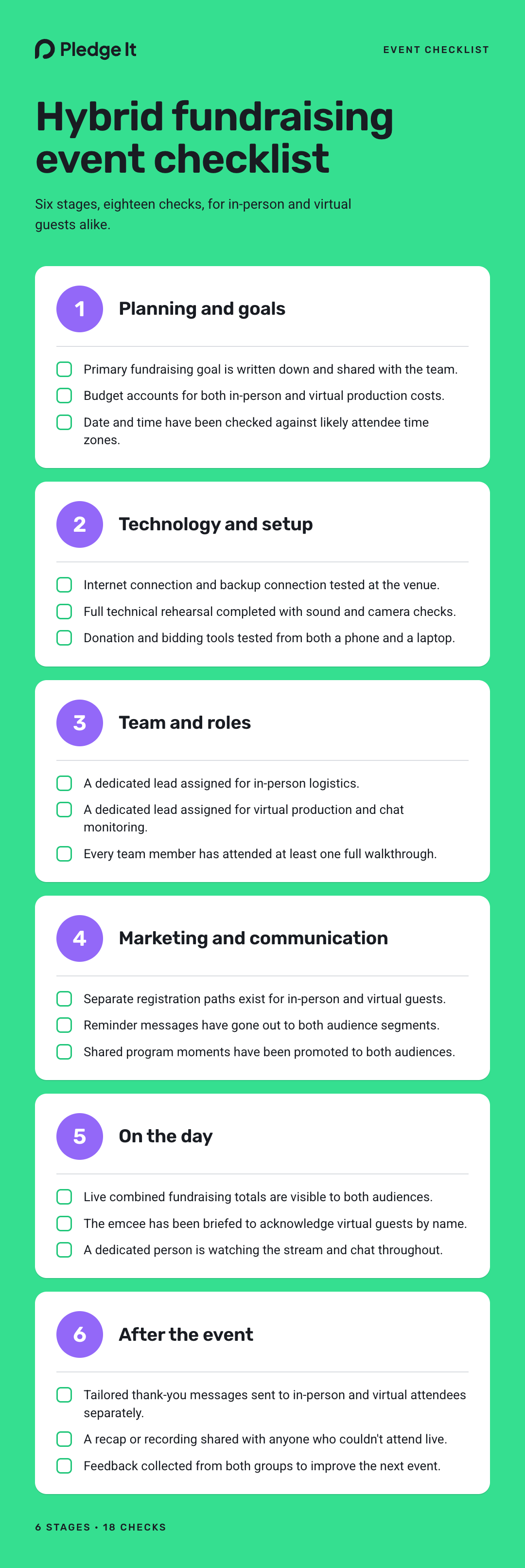
The easiest way to run hybrid fundraising events without missing something important is a checklist you actually reuse. We have compiled a printable checklist, so your team can run through it before each one, rather than rebuilding it from memory.
Success Story
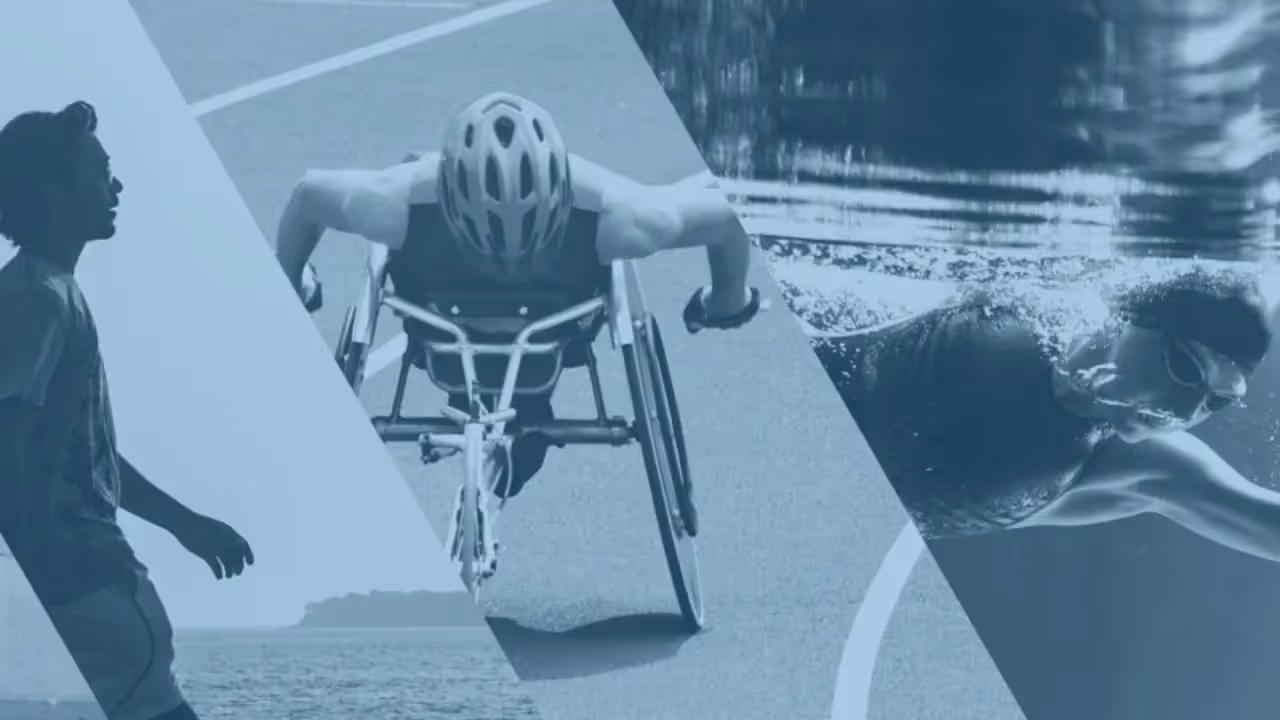
How Uplifting Athletes Ran Their First-Ever Virtual Fitness Challenge With Pledge It
Some nonprofits learn to rebuild an in-person event into a hybrid fundraising event, which is what Uplifting Athletes did. The organization ran its signature "Lift For Life" fundraising events on college campuses every summer.First Tee of Greater Charleston challenged its community to complete 100 holes of golf in a single day. Golfers walked, ran, and rode their way through the challenge, turning every hole into a pledge opportunity for supporters back home.
When campuses shut down, the nonprofit had days to replace an entire season of in-person events with something that could still bring its community together.
Working with Pledge It's peer-to-peer platform, the team built the "7,000 Mile Challenge." It was a fitness campaign where chapter leaders, supporters, and patients collectively worked toward covering 7,000 miles, one for every known rare disease.
The results outpaced their usual in-person turnout. Nearly twice as many participants became active fundraisers compared to a typical registration-fee walk or 5K, and those fundraisers raised 2.5 times more per person. Donors who made performance-based pledges gave 12% more than the average online gift, and participants joined in from the US, the UK, Germany, Spain, and the Philippines.
How to Make a Hybrid Event Accessible
The reason many of your supporters are watching from home is a barrier to attending in person. Building the stream without accessibility undercuts the premise. Here are a few ways to keep usability and user-friendliness in check:
- Turn on live captions: Zoom and other such tools both include automatic captioning at no extra cost.
- Plan where the ASL interpreter sits: If you're providing interpretation, the interpreter needs to stay in frame throughout, which means deciding the camera composition in advance is crucial
- Check contrast on your graphics: Sponsor lower-thirds and fundraising thermometers frequently fail contrast standards. Dark text on a light background, minimum 18pt equivalent, and never rely on color alone to communicate progress.
- Test the giving flow with a keyboard: Some donation forms can't be completed without a mouse. Tab through your own donation and bidding pages before the event.
- Caption the recording too: The version you share afterward reaches more people than the live stream in most cases.
- Say what's available in your invitation: Supporters who need captions or interpretation need to know before they register.
Get Started With Your Very Own Hybrid Fundraising Event
You don't need a big production budget to run hybrid fundraising events well. You need a plan that treats both audiences as equally real, from the first save-the-date to the last thank-you note.
Start smaller than you think you need to. Pick one upcoming event, add a single livestreamed moment, like the appeal or the fund-a-need, and build from there next time. Hybrid doesn't have to mean everything at once on the first try.
Ask last year's virtual attendees, if you had any, what would have made them feel more part of the room. That answer is usually more useful, since it comes straight from the audience you serve.
When you bring it together, Pledge It is a complete event fundraising platform that makes hybrid fundraising events efficient with a single dashboard and peer-to-peer fundraising tools. We help you run one event that suits both in-person and online audiences perfectly.