The last six weeks of the year decide more of your annual budget than any other stretch on the calendar. That's the reality behind year-end giving. It's why so many development teams feel the pressure build every November.
More than 30% of annual donations occur in December, and 10% of all annual giving happens in the final three days of the year. A short window carries a disproportionate share of the weight.
This guide covers why this season holds so much meaning, strategies to build into your plan, a step-by-step timeline, the 2026 tax changes, and best practices to keep donors engaged.
Why Do You Need Year-End Giving?
For most nonprofits, year-end giving is the single largest fundraising event of the year, and skipping a real strategy for it means leaving a serious amount of funding on the table.
December's share of online revenue, more than a third, which means the month runs at roughly 4x the pace of an average month. Everything your team does in those weeks carries four times the weight it would in April.
End-of-the-year giving also tends to bring in donors your organization didn’t already reach. This is because the season's cultural pull draws in people who give once a year and people who've never given before.
A plan that only shows up for this stretch instead of building toward it misses most of that opportunity.
A modest, well-timed plan usually outperforms a bigger, rushed one. Nonprofits that treat end-year giving as a season to plan for have the opportunity to come out ahead year after year.
Why the Year-End Invites Donor Attention and Giving
Donors do not give more in December by coincidence. Several predictable forces line up at once.
Extra Donor Budgets
Year-end bonuses, holiday budgets, and a general sense of financial reflection all land around the same weeks.
Many donors are simply deciding where discretionary money goes for the year, and a clear appeal puts your cause in that conversation.
Tax Deduction Deadlines
The December 31st deadline for tax-deductible giving creates urgency. Donors who've been meaning to give often finally act once the calendar year is about to close, especially for year-end charitable giving tied to itemized deductions.
Cultural Momentum
GivingTuesday, holiday news coverage, and a general cultural conversation about generosity all build on each other through November and December.
GivingTuesday 2026 falls on December 1, and raised $4.0 billion in the US in 2025, up 13% year over year. Your appeal benefits from that momentum whether or not you run a GivingTuesday campaign of your own.
What Changed for Donors in 2026
One change is worth knowing before you write your appeals. Beginning with the 2026 tax year, donors who take the standard deduction can claim a charitable deduction again, up to $1,000 for a single filer and $2,000 for a married couple filing jointly, on cash gifts.
Around 9 in 10 taxpayers take the standard deduction, so for the first time since 2021, the large majority of donors get a tax benefit from giving. Gifts to donor-advised funds and certain private foundations don’t qualify.
Rules also changed for donors who itemize and for corporate gifts. Those are more involved and they cut both ways depending on the return, which makes them a conversation for a tax professional rather than something to put in appeal copy.
What to actually do with this:
- Mention it, carefully. “You may be able to deduct your gift even if you don’t itemize” is accurate for most donors this year.
- Say “may,” never “will.” Whether any individual donor benefits depends on their own return.
- Brief whoever answers the phone. Donors will ask, and a confident wrong answer from a staff member is worse than “let me find out and call you back.”
- Get receipts out fast. Documentation matters more in a year when the rules have moved.
Note: This is general information, not tax advice. Encourage donors to confirm their own position with a tax professional.
7 Strategies for Year-End Giving for Nonprofits
Looking at year-end giving campaign examples from other nonprofits can help, but these 7 can be built into your own plan, in whichever order fits your organization's calendar.
1. Gather Your Team Early On
This doesn't need to be a formal process. A short planning meeting in September or October, with clear roles written down, is usually enough to keep everyone aligned.
2. Keep Goals Clear and Handy
A vague goal like "raise as much as we can" doesn't give your team or your donors anything to rally around. A specific number, tied to a specific purpose, does both.
Keep that number visible on your donation page, emails, and social posts. Consistency turns an abstract goal into something donors can watch progress toward.
3. Invest in Complete Event Fundraising Tools
Many nonprofits run year-end giving through a patchwork of tools, where one is for donations, another is for events, and a spreadsheet tracks it all. This is where things can go wrong during your busiest weeks.
Pledge It is a complete event fundraising platform that keeps donation forms, event pages, and reporting on one dashboard, with centralized messaging to donors and participants, automated branded receipts, and integrations with Mailchimp and HubSpot for campaign email.
4. Make Storytelling a Part of Strategy
A generic year-end giving summary doesn’t move anyone to give. A specific story, about one person or one moment your work made possible, almost always performs better.
Pick one story per major appeal, and let the numbers support it. Donors remember people, and a well-told story gets shared further than a well-designed graphic.
5. Build an Online Giving Strategy
Most year-end gifts happen online, often from a phone in a matter of minutes between other things. A donation page that loads slowly or asks for too much information loses gifts.
Test your own donation flow on a phone before the season starts. If it takes you more than a minute to complete, it's costing you donors.
6. Optimize Your Website
If a donor has to hunt for your year-end campaign, many simply won't. Your homepage should make it obvious, within a few seconds, that a season-specific way to give exists.
A dedicated banner or a clearly labeled button works better than burying the campaign inside a general donate page.
7. Segment Your Donors
A first-time donor, a lapsed donor, and a longtime monthly giver do not need the same appeal. Even a simple three-group split, new, lapsed, loyal, lets you write appeals that speak to where each donor already stands.
Your Week-by-Week Timeline to December 31
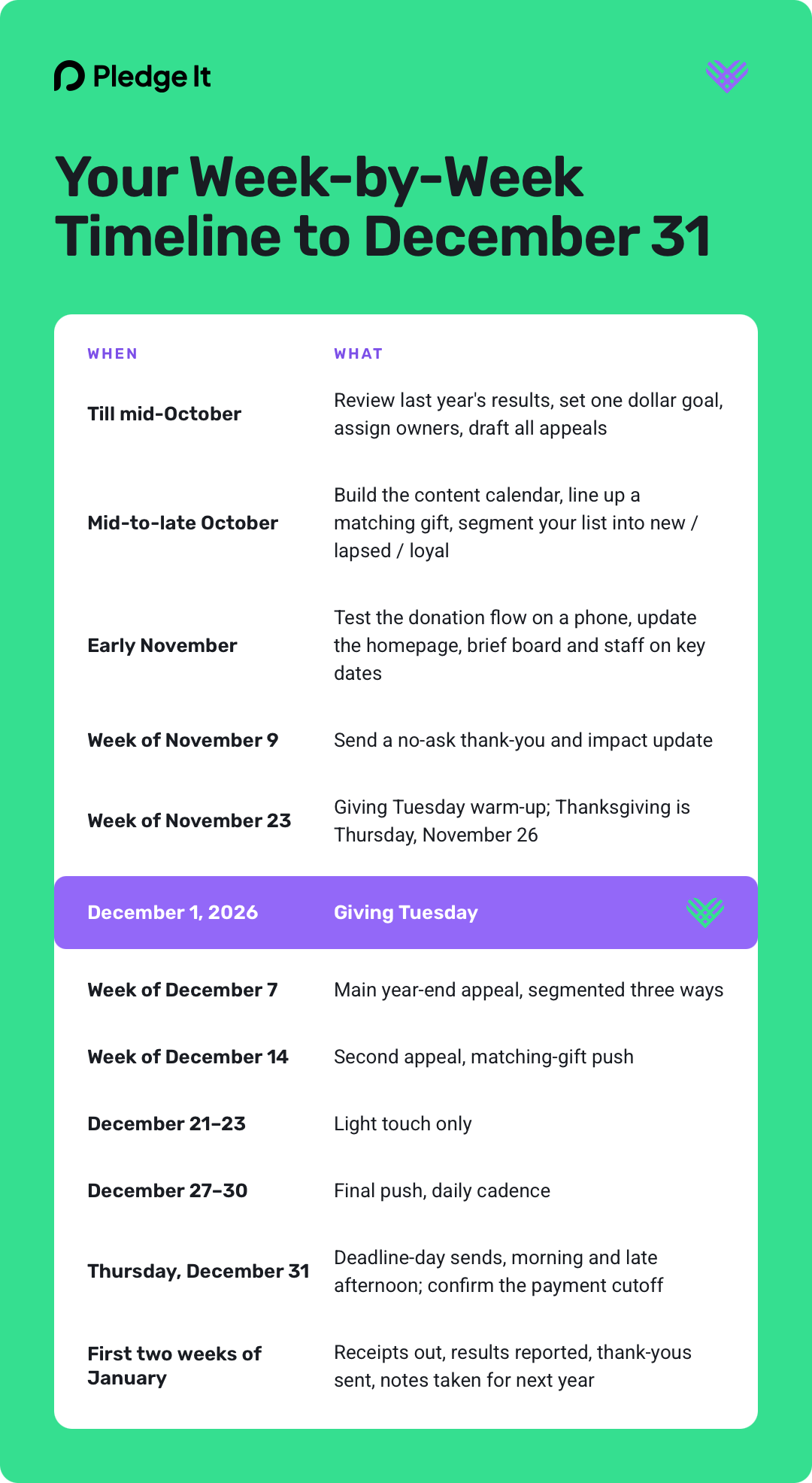
How to Plan the Timeline for Year-End Giving
A strong strategy still needs a realistic schedule behind it. These five steps give your team enough runway to execute without a last-minute rush:
Step 1: Assess Your Fundraising Standards and Goals
Before building anything new, look honestly at last year's results. What worked, what didn't, and what number makes sense as this year's target.
- Review last year's results: Pull final numbers from last year's campaign as your baseline.
- Set a specific target: Choose one dollar goal tied to a clear purpose, not a vague hope.
- Note what underperformed: Flag anything from last year worth changing before repeating it.
Step 2: Plan Ahead of Time for Appeals
Year-end appeals written the week they're due tend to read that way. Drafting them earlier, while there's still room to revise, produces stronger copy and gives your team breathing room during the busiest weeks.
- Draft appeals in October: Write first drafts well before your first send date.
- Build a content calendar: Map out every email, post, and mail piece before the season starts.
- Leave room for review: Give at least one other person time to read and edit each appeal.
Starting early means having a good repository of ideas. Check out winter fundraising ideas you can keep handy.
Step 3: Develop Your Fundraising Calendar
A calendar turns your strategy into specific aspects, like GivingTuesday ideas, mid-December reminders, and the final December 31st push. Without it, timing tends to happen by instinct instead of plan.
- Mark key dates: Plot GivingTuesday, mid-December, and December 31st as anchor points.
- Space out touchpoints: Avoid clustering every appeal into the same single week.
- Share the calendar team-wide: Make sure everyone knows what's going out and when.
Step 4: Choose The Right Tools
The right fundraising platform makes every other step in this timeline easier. The wrong one adds friction exactly when your team has the least time to deal with it.
- Look for one dashboard: Choose a tool that handles donations, events, and reporting together.
- Check the mobile experience: Test the actual donation flow on a phone before committing.
- Confirm real support access: Make sure help is available when something breaks mid-campaign.
Pledge It is built around complete event fundraising, keeping donation forms, event pages, and reporting connected in one dashboard. It has a dedicated Customer Success Manager to help plan the season as well.
Step 5: Set Up Your Marketing Efforts
Even the best campaign underperforms if nobody hears about it. Marketing efforts should be scheduled with the same care as the appeals themselves, across every channel your donors actually use.
This is also where the earlier work pays off. A team that already has its calendar and appeals ready spends this step executing.
- Coordinate across channels: Align email, social, and any direct mail around the same key dates.
- Prepare social content ahead: Draft and schedule posts before the season gets busy.
- Brief your whole team: Make sure board members and staff know the key dates to help amplify.
Cultivating Year-End Giving: 6 Best Practices to Fulfill This
These 6 practices are what keep that plan feeling human throughout the season, instead of like a countdown of appeals.
1. Get in Touch With Volunteers
Volunteers are often your most credible messengers, since they've chosen to give their time to your cause already. Looping them into year-end efforts extends your reach past what staff alone can cover.
- Give them ready-to-use messages to share with their own networks
- Thank them by name in appeals where appropriate
- Share campaign totals with them, not just with the public
2. Look for Matching Gifts
Matching gift opportunities, whether from a single major donor or a corporate program, can meaningfully boost a campaign's total for very little extra effort.
Identifying them early lets you build the match into your messaging, and a match tends to create urgency that a standard appeal doesn't.
- Ask supporters about employer matches: A simple prompt during checkout can surface eligible gifts.
- Look for a matching sponsor: A board member or business partner willing to match gifts adds urgency.
- Promote the match clearly: Make sure donors know a match exists before they give.
3. Let Donors Know You Care
A donor who only hears from your organization when you need something eventually stops responding. Genuine, no-ask communication throughout the season builds the relationship that makes the ask work later.
- Send a thank-you before an ask: Open the season with gratitude, not a request.
- Personalize where you can: Even a first name and a specific detail go a long way.
- Follow up after every gift: A prompt, warm receipt matters more than donors let on.
4. Stay Updated on Tax Deductions
Tax rules around charitable giving can shift, and donors often have real questions about deductibility as December 31st approaches. Staying current protects your organization from giving out incorrect guidance.
- Confirm current-year rules: Check for any changes before the season's final push.
- Point donors to a tax professional: Avoid giving specific tax advice yourself.
- Send receipts promptly: Donors often need documentation before they file.
5. Document and Show Impact Clearly
Donors who can't see what their gift did are less likely to give again. Clear, specific impact reporting closes the loop and sets up next year's ask, and it's often the single most underinvested part of a year-end strategy.
- Share real numbers: Report what last year's gifts specifically funded.
- Use photos and stories: Pair numbers with a face or a moment.
- Report back within weeks: Timely follow-up keeps the impact feeling current.
6. Clarify the Kinds of Donations You Value
Not every gift looks like a one-time check. Being clear that monthly gifts, stock donations, or in-kind support are all welcome can unlock giving that a cash-only appeal might miss.
- Name the options explicitly: List monthly giving, stock gifts, and other formats by name.
- Make each option easy to act on: Don't bury alternate giving methods behind extra steps.
- Explain why it matters: A short note on how recurring gifts help your planning encourages them.
Following up with a thank-you, a receipt, and an impact update for every single donor takes real staff time at scale. Pledge It automates compliant, branded receipts and thank-you messages, so that follow-through happens without extra manual work.
Success Story
How Pledge It Helped First Tee Contra Costa Build A Real Giving Program
Strong year-end giving doesn’t exist in isolation. It grows out of a connected giving program built over time, which is the gap First Tee Contra Costa needed to close.
When Brandon Garcelon joined First Tee Contra Costa as Executive Director in 2024, the chapter had more than 20 years of history but no individual giving program. Fundraising ran almost entirely on two annual events, with no way to connect donors, events, and dollars into one picture.
As Brandon put it, he wanted a platform that could capture every donor's information in one place and use it to build a real annual giving plan.
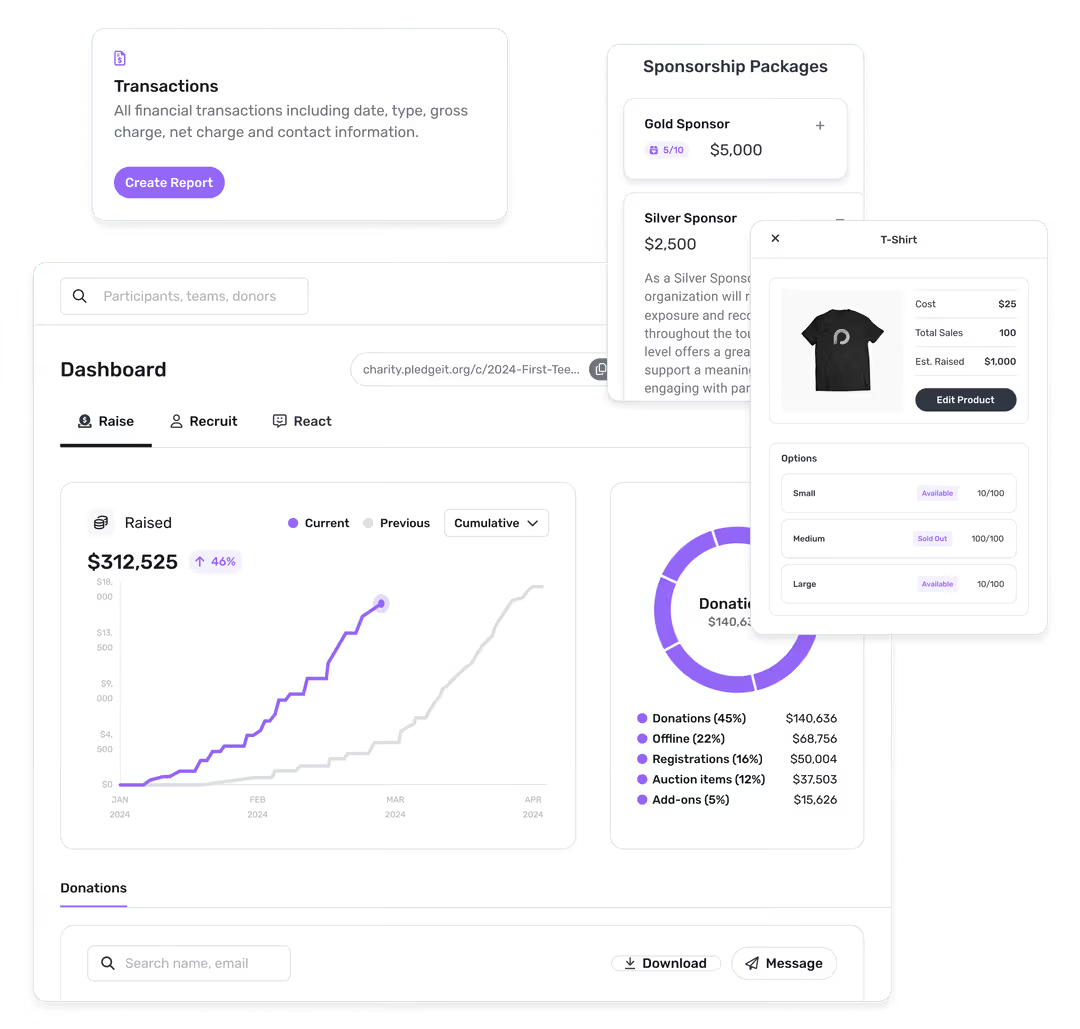
Pledge It gave the chapter a single system for donor tracking, event registration, and sponsorship management, connected for the first time. That visibility let the team see donors as ongoing relationships, which is the shift a real giving program depends on.
Annual fundraising grew from roughly $25,000 to a projected $150,000 in under two years, close to 500%.
That same foundation, one connected system tracking every donor touchpoint, is what makes a strong year-end giving season possible.
Making Year-End Giving an Easier and Fruitful Ritual
The nonprofits that handle this season well are the ones with a plan they actually built ahead of time. Pick your single best-performing appeal from last season, and ask why it worked.
More often than not, the answer is specificity, like a real story, a number, a deadline. That's a formula you can repeat instead of reinventing.
A season this concentrated gives you a fast, real answer about what your specific donors respond to, one you can carry into next year instead of guessing again.
As you build out your own year-end appeals, remember that consistency matters more than intensity. A steady cadence of communication outperforms a flurry of asks.
With Pledge It, a complete event fundraising platform, donation forms, event pages, sponsor tracking, automated receipts, and real-time reporting all stay on one dashboard.
These are backed by a dedicated Customer Success Manager who helps plan the season with you. If your team is heading into year-end giving with more tools than time, Pledge It is built to bring that back down to one.


