Picture a small animal shelter in Ohio with one donated weekend getaway, a modest email list, and a goal of $3,000. Six weeks of selling ahead of them, and no idea whether it’ll work.
What decides the outcome isn’t the prize. Plenty of nonprofits raffle off something great and still watch ticket sales stall at week three.
What separates the raffles that hit their number is a plan: the right ticket price, a few smart bundles, and a promotion push that holds steady right up to the final hour.
That's the part most organizers overlook. Raffles don't succeed on prizes alone. They succeed on proper planning, a solid strategy, and a clear timeline that lets you start and finish on a high note. And the right raffle platform can go a long way in simplifying the process.
We’ll walk you through the exact process of selling a raffle ticket, and with our free calculator to get you started in no time.
Before You Sell: Understand Raffle Legal Requirements
Raffle rules vary from state to state, and they shape your format, your price, and where you can sell. Some states restrict online ticket sales, and a few do not permit paid raffles at all.
Always check your own state's requirements before you decide on anything else.
Here are the main rules to keep in mind when selling raffle tickets:
Registration or Licensing
Most states require registration before you solicit donations from their residents, even when your organization is based in another state.
You will also need a separate permit before selling raffle tickets, usually from your state's charitable gaming agency or the attorney general's office.
Many states exempt small raffles from that permit. Minnesota, for example, lets 501(c)(3) groups skip it when prizes for a single event stay under $5,000. Thresholds vary widely from state to state, so see whether you require a permit at all before you assume you need one.
Sales Channels
Some states let you sell tickets online, others limit you to in-person sales, and a few draw the line at state borders.
So, online selling comes with a risk. Once your ticket page is public, supporters in other states can find it, which can pull you into states where paid raffles are not allowed, including the few that ban them outright.
Check whether your platform can limit ticket sales by state, and confirm whether your own state allows sales to out-of-state buyers.
Reporting
Many states ask for a post-raffle report covering gross receipts, prizes awarded, and expenses. Deadlines usually fall between 30 and 90 days after the drawing.
When a prize is worth $2,000 or more and at least 300 times the ticket price, report the winner to the IRS on Form W-2G. A $5 ticket that wins a $2,000 prize clears both tests, so collect the winner's details right at the draw.
Gross gaming income above $15,000 in a year means filing Schedule G with your Form 990, and running raffles very regularly can raise unrelated business income questions. Your accountant can confirm both.
Ticket and Prize Limits
Certain states impose limits or additional requirements based on ticket price, prize value, or total proceeds. For example, Massachusetts applies additional raffle regulations when tickets cost more than $10 or prizes exceed $10,000.
When the prize value minus the ticket price tops $5,000, federal withholding of 24% applies. For a cash prize, you hold back that amount and send it to the IRS. For a noncash prize such as a car, the winner usually pays the 24% to you before taking it home.
Consider this when you pick the prize. Stay under the threshold, or set the 24% aside so it never blindsides the winner.
Where Paid Raffles Are Not Allowed
Alabama, Hawaii, and Utah generally do not permit standard paid-entry charitable raffles.
Florida allows charitable drawings but bans requiring any payment to enter. California takes a different route, permitting paid raffles with attorney general registration while prohibiting online ticket sales, so you sell in person only.
If your nonprofit operates in one of these states, you'll need to consider a different fundraising format such as an auction.
Note: State raffle laws change often, and thresholds vary widely. Confirm your current rules with your local charitable gaming office or attorney general before selling any tickets.
How to Sell Raffle Tickets: Key Things to Know First
The raffles that hit their goal start with one clear number: how much the campaign must raise. Everything else, from the prize you pick to the price you set, works back from that figure.
Here are the key decisions to make before you set your pricing:
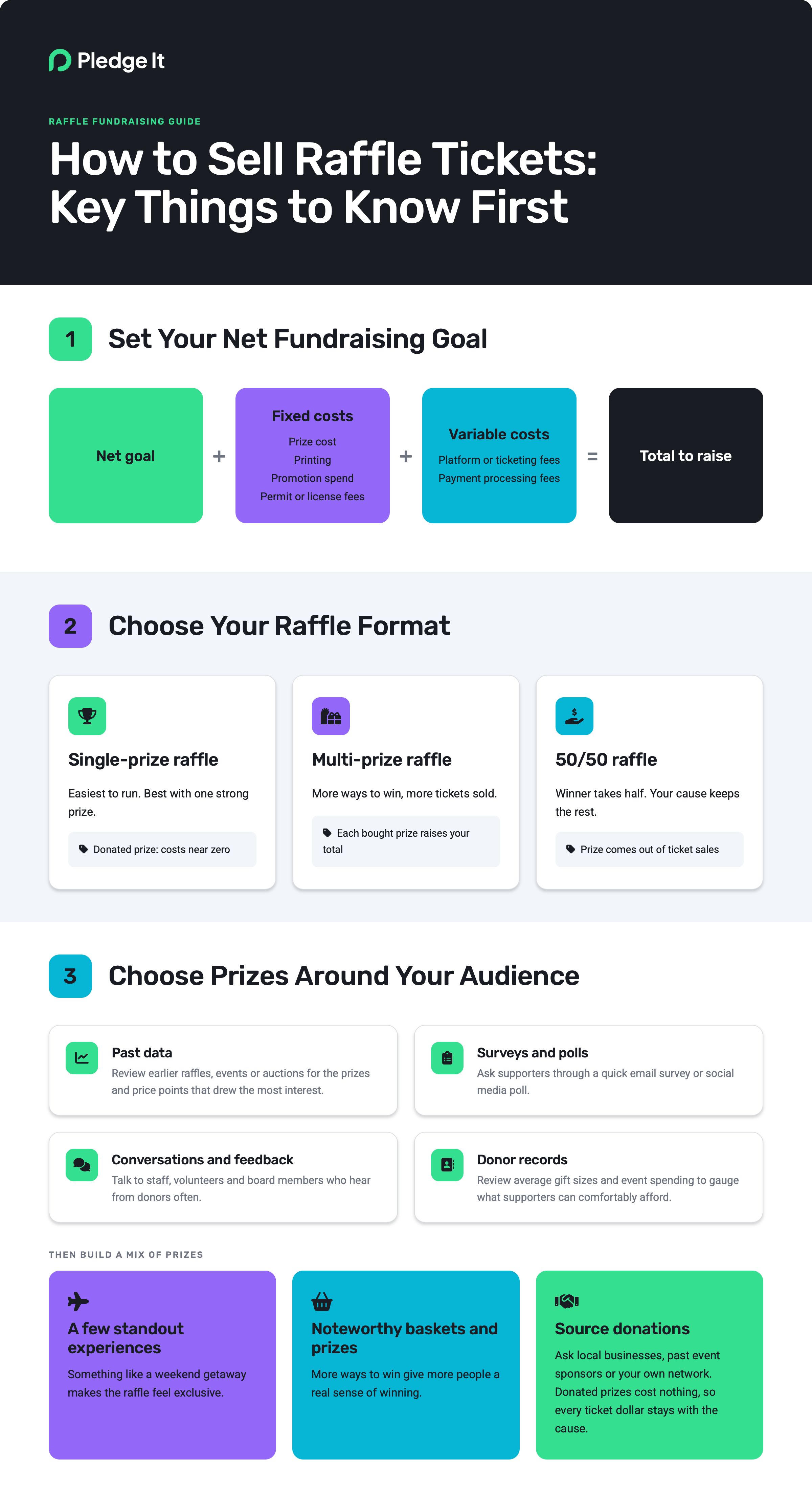
1. Set Your Net Fundraising Goal
Set your goal around what you want to raise for your cause, and account for every cost that comes out of your total.
Fixed costs (the same whatever you sell):
- Prize cost, if you are buying the prize instead of getting it donated
- Printing costs for physical tickets, flyers, or signage
- Promotion spend, such as paid social ads or boosted posts
- Any permit or license fee your state requires
Variable costs (these scale with your sales):
- Platform or ticketing fees charged per ticket sold
- Payment processing fees, usually a percentage plus a flat charge per transaction
2. Choose Your Raffle Format
Your format shapes your prize cost, your ticket price, and the amount of work the raffle requires to run. Here are the different kinds and what each would cost:
Single-prize raffle
It is the easiest to run and works best when you have one prize strong enough to carry the campaign, like a donated getaway. A donated prize keeps your costs near zero, so more of every ticket goes to your cause.
Multi-prize raffle
More ways to win make people more likely to buy, which suits larger supporter lists and events. The catch is cost: each prize you buy increases the total you must clear, so lean on donations and price your tickets to cover the remainder.
50/50 raffle
The winner takes half the money raised, and your cause keeps the rest. The prize cost comes straight out of ticket sales, so keep that in mind when you price.
3. Choose Prizes Around Your Audience
Consider your target audience's interests, preferences, and spending habits to understand what they would actually want. Here’s how you can do it:
- Past data: Review earlier raffles, events, or auctions to see which prizes and price points drew the most interest.
- Surveys and polls: Ask supporters directly through a quick email survey or a social media poll about the prizes they would want.
- Conversations and feedback: Talk to staff, volunteers, and board members who know your community well and hear from donors often.
- Donor records: Review average gift sizes and event spending to gauge what your typical supporter can comfortably afford.
Once you understand who you are selling to, build a mix of prizes rather than betting on one.
Offer a few standout experiences, such as a weekend getaway, to make them feel exclusive. Then add other noteworthy raffle baskets and prizes that give more people a real sense of winning.
For sourcing, reach out to local businesses, past event sponsors, or your own network for donations. Donated prizes cost you nothing, so every ticket dollar stays with the cause.
Raffle Ticket Price Calculator
How Much to Sell Raffle Tickets For: The Pricing Strategy
The raffle ticket price is the single biggest lever on what your raffle earns. The right amount sits where your costs and your buyers' willingness to pay meet. Here’s how to reach that number:
The Core Pricing Formula
Start with the net goal you set during planning, then add every expense back on top. Divide that total by the number of tickets you expect to sell. The result is your baseline ticket price.
(Net goal + total expenses) / Expected tickets sold = Ticket price
Using the example above: $4,891 ÷ 700 expected tickets = $6.99, which you round to $7.
How to Estimate Your Ticket Volume
Base your ticket estimate on the audience you can realistically reach. Decide this by looking into your
- Email list
- Social media following
- Event turnout
- Board and volunteers network
A common planning range can be around 10 to 20 percent of your reachable audience buying at least one ticket.
For instance, a list of 2,000 contacts at 15 percent gives you 300 buyers. If each buyer takes two tickets on average, that points to around 600 tickets sold.
Lean toward the lower end of that percentage range. Some of your contacts might not buy, so a cautious estimate protects your price.
Types of Fundraiser Raffle Ticket Pricing
Your pricing structure directly affects how much each supporter spends. Most raffles use one of two approaches, and the strongest campaigns combine both.
Single-Ticket Pricing
A single-ticket price is a fixed cost for a single entry, such as $5 per ticket. It sets the foundation for your whole pricing structure and gives first-time buyers a simple, low-commitment way in.
How to price it:
Use your formula to set this base rate first, since every bundle builds on top of it.
Bundle or Tiered Pricing
Bundle pricing offers a lower per-ticket rate when supporters buy in volume, such as 1 for $5 or 5 for $20. The savings reward bigger purchases and push up your average sale.
How to price it:
- Set a clear single-ticket price, such as $10 for one ticket
- Add a mid-tier bundle at better value, such as three tickets for $25
- Offer a larger bundle for generous buyers, such as ten tickets for $75
- Keep it to about three tiers so the choice is easy to make
Raffle Ticket Price Benchmarks By Prize Tier
The ranges below show what nonprofit raffles usually charge at each prize tier. Use them to pressure-test your formula's price. If your number lands well outside the range for your prize value, revisit your volume estimate or your prize choice.
Common Raffle Pricing Mistakes to Avoid
A sound formula only works if the fundamentals hold up around it. Most fundraiser raffle tickets lose money to a few avoidable errors that quietly undercut the price. So, run through these mistakes before you settle on a final number:
- Mispricing your ticket: Too low leaves you short after prize and fees, and too high stalls both single tickets and bundles.
- Overlooking fees: Platform and processing fees eat into your margin when you leave them out of your cost estimate.
- Skipping bundles: A single price gives your most generous supporters no way to buy more in one purchase.
- Using odd numbers: Prices like $7.50 slow down every sale and weaken the quick impulse buys raffles rely on.
- Mismatching prize and price: A ticket has to feel like a small ask next to the prize, or buyers scroll past.
- Selling before your permit clears: Approval can take days or weeks by state, and tickets sold beforehand can void the whole raffle.
- Setting a prize that triggers withholding: A prize over $5,000 means the winner owes 24% upfront, so plan for it or stay under that threshold.
Where to Sell Raffle Tickets: Online, In Person, or Hybrid
The best place to sell raffle tickets depends on your audience, fundraising setup, and local raffle regulations.
Online selling widens your audience while in-person selling builds a personal connection, and hybrid combines both. Your state's rules can limit your options, so check what is permitted before you decide on a route.
What Every Ticket Must Show
Before you decide where to sell, build your raffle ticket to carry the details most states require:
- Legal name and permit number of your organization
- Prize description, retail value, and ticket price
- Date, time, and location of the drawing
- Attendance requirement for the winner
- Statement that the purchase is not tax-deductible
Selling Raffle Tickets Online
Online selling removes the friction of paper tickets and cash handling. Your supporters can buy in with a few taps and share the raffle page with their own networks, extending your reach well beyond your direct contacts.
To sell raffle tickets online effectively, set up a few essentials:
- A dedicated ticket page with a clear prize, your price tiers, and the draw date shown up front
- Mobile-friendly checkout, since most buyers arrive from a phone and abandon anything clunky
- Shareable links so supporters can spread the word for you across their own networks
- Automatic receipts and entry confirmations, so every buyer gets a record without extra work from you
Selling in Person
Use your fundraising gala events, community gatherings, and donation drives to sell in-person tickets. The people showing up already believe in your cause, which makes them your warmest audience for tickets.
Keep a few things ready for in-person selling:
- Accept both cash and card payments, using a system that logs every buyer so no sale slips through
- Brief volunteers on exactly where the funds go, so they can sell with confidence
- Position sellers where foot traffic peaks, near entrances, food, and registration desks
- Display the prizes or their visuals to draw people in and prompt them to buy
- Put up clear signage with the ticket price, the prize, and the cause behind it
The Hybrid Approach
A hybrid fundraising event approach runs your raffle online for several weeks, then adds in-person selling on fundraising event day. The two channels support each other: the online push warms people up, while being there in person closes the supporters who meant to buy but never got around to it.
A hybrid raffle tends to work best when you:
- Pick a single raffle platform that manages both your online and in-person sales, so every ticket lands in one record
- Start selling your raffle tickets online four to six weeks ahead, giving distant supporters plenty of time to buy
- On event day, push in-person sales by naming the impact, showing how a set number of tickets funds a specific outcome
- Send a few text reminders between launch and event day, spaced out so each one still feels worth opening
How to Set Up Your Raffle Campaign Page for Conversions
Your raffle campaign page is where interest turns into funds and should guide the visitor toward a purchase. Keep the layout clear, the copy focused, and the checkout short.
A cluttered or confusing page loses potential supporters who arrive ready to buy the tickets. Here's how to set up your raffle page so it converts:
- Lead with the prize and the cause: Put the prize and what it funds in the hero section, so visitors see both the reward and the purpose at first glance.
- Make pricing and bundles easy to scan: Lay out ticket tiers and bundles clearly, with a buy button that stands out, so visitors can act fast.
- Include the raffle calculator: Add your ticket price calculator so buyers can weigh a bundle before they commit and lean toward a larger one.
- Write copy that drives the purchase: Open with the cause, follow with the prize to build appeal, then close with urgency tied to the drawing date.
- Reduce checkout friction: Keep the form to a few fields like name, email, and payment details, and build it mobile-first, since most people pay from their phone.
- Add trust and momentum signals: A live progress bar, a countdown to the draw, and a past winner spotlight build confidence and urgency at once.
6 Ways to Promote Your Raffle and Lift Ticket Sales
Promote your raffle across the channels your supporters already use, and let word-of-mouth carry it further. Make sure to start early, ideally six to eight weeks before the draw.
More importantly, state and local raffle laws govern how tickets can be distributed and whether your organization can sell them online. So when planning your promotion, confirm the rules for advertising through your website, email, social channels, or a third party.
Here are some tactics that you can use to sell raffle tickets:
1. Partner With Local Businesses
They can help you reach supporters where they already spend time, and put you in front of new audiences who have never heard of your cause. Reach out and ask if they would:
- Display a raffle flyer with a QR code near the register or entrance
- Let an authorized volunteer set up a ticket table
- Share your raffle on their social media and tag your organization so followers can find you directly
- Keep a small stack of tickets at the counter, with a printed sign explaining the cause
Note: Confirm whether third parties are allowed to sell raffle tickets, and whether the business needs formal authorization first.
2. Tap Into Your Email List
Your nonprofit already has a list of people who care enough to hear from you, which makes email one of your strongest channels for a raffle.
Rather than a single blast, guide subscribers through the campaign with a short sequence, so the raffle stays visible from launch to final draw.
- Start with your newsletter: Fold the raffle into your monthly newsletter so the first mention reaches people in content they already open.
- Send dedicated emails: Once the raffle opens, give it an email of its own that tells your story and signs off from a real person.
- Segment where you can: Tailor the message so past supporters get a welcome-back nudge and first-timers get a simple introduction.
- Close with a reminder: In the final days, send a brief reminder with the deadline and a single link to catch anyone who forgot.
3. Equip Supporters for Peer-to-Peer Selling
Turn the people closest to your cause into peer fundraisers. Volunteers, staff, and board members reach circles you never will. Give each of them the link to your raffle campaign or personal page that credits every ticket back to them.
Then make the selling worth it. Recognize top peer sellers publicly, celebrate milestones as they happen, and reward whoever moves the most tickets.
4. Lean on Early-Bird Pricing to Reward Early Buyers
Early-bird pricing gives supporters a small discount or bonus for buying before a set date. It creates urgency at the start of your campaign, when momentum matters most.
Offer a lower rate or an extra entry for tickets bought in the first week, then return to your standard price. For example, sell tickets at 5 for $18 during the early-bird window, then move to 5 for $20.
You can also swap the discount for a perk, like a bonus entry or a small add-on prize for early buyers. This rewards your most eager supporters and gives you an opening-week sales spike to build on.
Tip: Announce the early-bird deadline clearly, and send a reminder the day before it ends to capture last-minute buyers.
5. Post a Social Countdown Series
Build a series of posts to promote your raffle fundraiser online. A steady sequence holds attention, builds curiosity, and gives supporters more than one reason to enter before the draw closes.
Here's how to plan each one as the draw date gets closer:
- Start with teaser posts: Share a hint or a sneak peek of the prize without giving it all away, so supporters get curious before the raffle opens.
- Follow with a prize reveal: Show clear photos of the full prize with a short line on what each ticket helps fund, so entering feels like giving.
- Share the entry details: Post the ticket price, the draw date, and a direct link, so supporters know exactly how to take part.
- End with countdown posts: As the date nears, add reminders like "3 days left" to encourage a final wave of support.
6. Make a Final 48-Hour Push
In raffle fundraising, the last two days often bring the biggest rush of sales. A deadline pushes people to act, since no one wants to miss their shot once the clock is running down. So make sure you have a plan for those final hours:
- Email a "closing tonight" note: Send one short, urgent message with the deadline and a single link.
- Text the almost-buyers: Reach everyone who visited the page but did not check out.
- Post a last-chance update: Share a live ticket count so the draw feels close and real.
- Rally your peer sellers: Ask volunteers and board members for one last push to their circles.
Running the Drawing
Selling the last ticket isn't the end. How you run the draw is what protects the raffle if anyone ever questions the result.
- Use a genuinely random method. A random number generator, a drum, or your platform's built-in draw. Whatever you use, be able to explain it.
- Have a witness present who isn't connected to the organization, such as a board member's guest, a volunteer from another group, or a notary if your state requires one.
- Record or livestream it. A short video removes any doubt and makes good content for thanking your supporters.
- Announce the winner publicly and notify them directly the same day.
- Collect the winner's details before handing over the prize, particularly if the prize triggers W-2G reporting or withholding.
- Document how the draw was conducted and keep your records for the period your state requires, often several years.
One thing to settle before you sell a single ticket: whether the winner needs to be present. Put it on the ticket and the page, and don't change it afterward.
Start Selling Smarter and Raise More for Your Mission
A successful raffle starts with a clear fundraising goal. Price your tickets based on three factors: how much you need to raise to support your program, what your donors are willing to spend, and the value of your prizes.
Once your pricing is set, map out your promotion week in advance. Start with pre-launch teasers to build anticipation, then a launch push when sales open. Keep momentum with mid-campaign reminders, and finish with a final countdown as the draw nears.
The best way to make planning and running a raffle easier is to pick the right platform.
Pledge It is a complete raffle platform that gives you one place to set up your raffle page, sell tickets, draw winners, and track payments.


